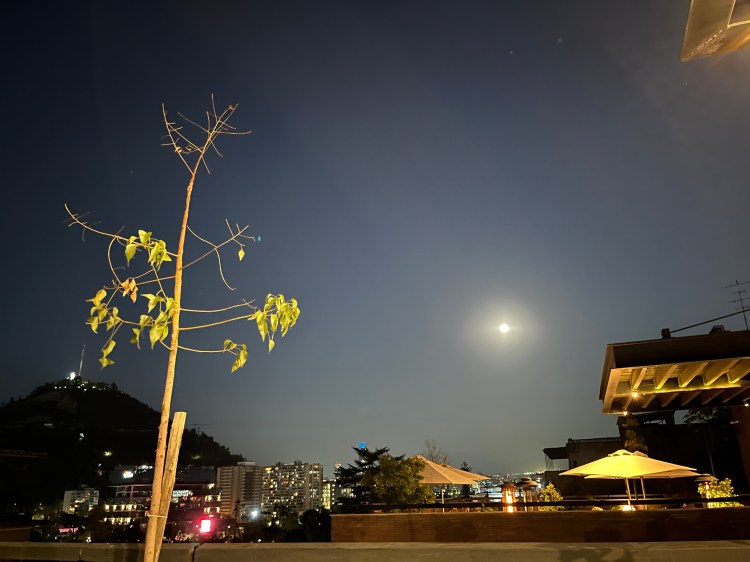
That evening, we had dinner in the rooftop restaurant of the hotel and watched the full moon rise.
Moonrise over Santiago
The next morning, Marco picked us up and drove us to the airport.
Checking in was easy but there was a huge queue for immigration. When we arrived in Chile, they gave each of us a “tarjeta de turismo”, or tourist card. We were told in no uncertain terms by several people to make sure we didn’t lose it or we wouldn’t be able to leave the country. When we finally got to the front of the queue, the immigration guy didn’t even look at them!
We spent a couple of hours in the very comfortable LATAM VIP lounge, then boarded our BA flight to London.
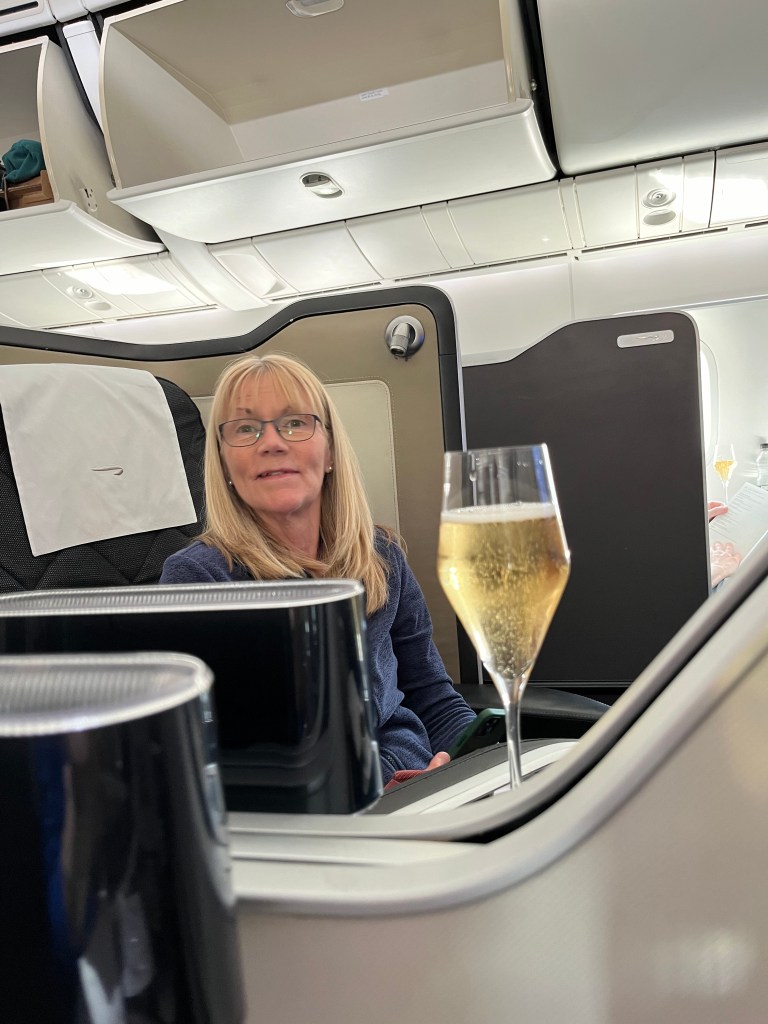
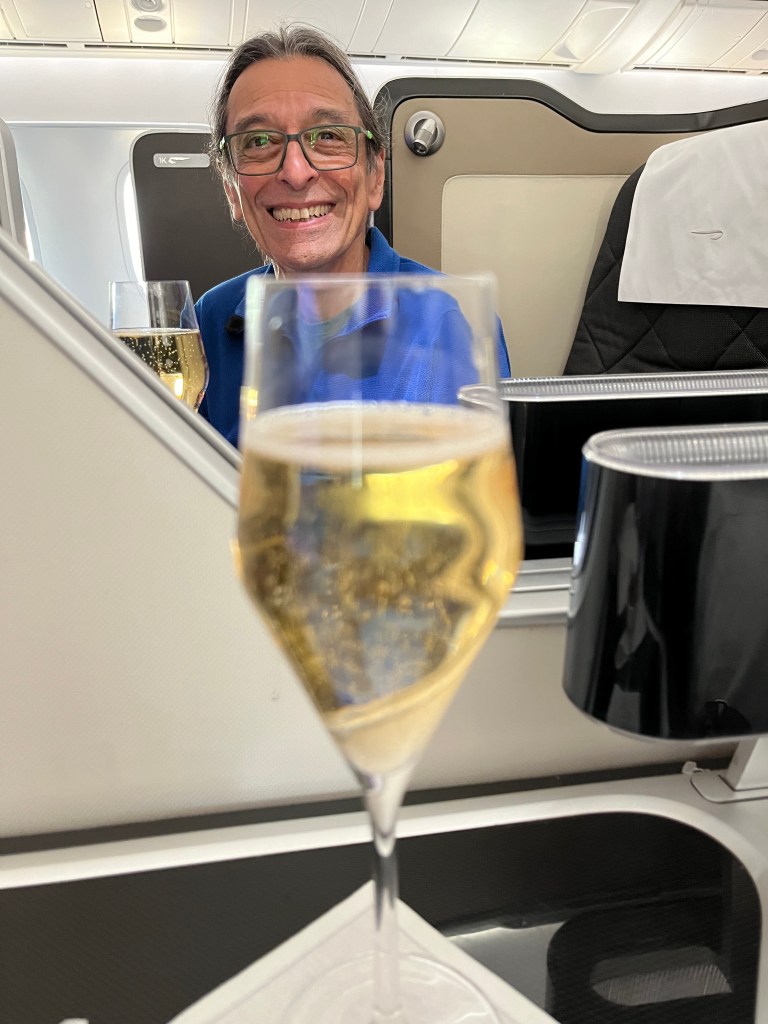
Flying homeAnd we were still on the ground!
And when we got to Heathrow, our bags were the third and fourth onto the conveyor, so we got to the meeting point before John from JPD travel. We were home before we knew it – mainly because I was asleep in the car.
I was still having problems with my arm, so I made an appointment that afternoon at the doctor’s. She confirmed that there was probably nerve damage from my injection; if it doesn’t go in four weeks, I have to go back and see them.
So, all we have left to do is raise an insurance claim and then decide where our next travels will take us.
This morning we had a new guide, Katia. We were whisked off to the South and the Maipo Valley. Whisked slowly, since it was the morning rush hour. We had a date with Haras de Pirque, one of the mid-sized wine producers of the area.
The estate
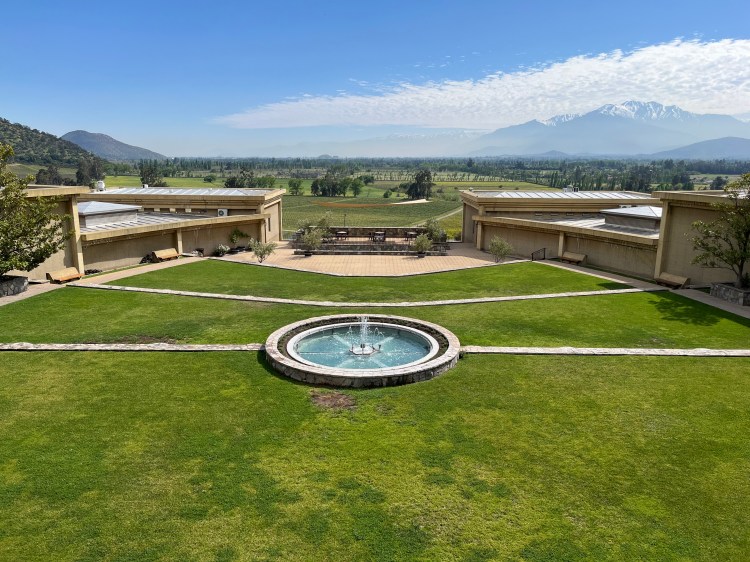
Our guide for the tour was Mathias, who came to the estate after studying tourism. The estate was originally a stud farm, but the Chilean owner planted some grapes in 1993 with a view to diversifying. The buildings are arranged in a horseshoe shape, and their signature wine is named after a famous horse – if you know about horses.
In the early 2000s, the Antinori family, wine makers in Italy for 600 years, bought the estate and have been developing it ever since. They focus on producing vegan, organic and sustainable wines.
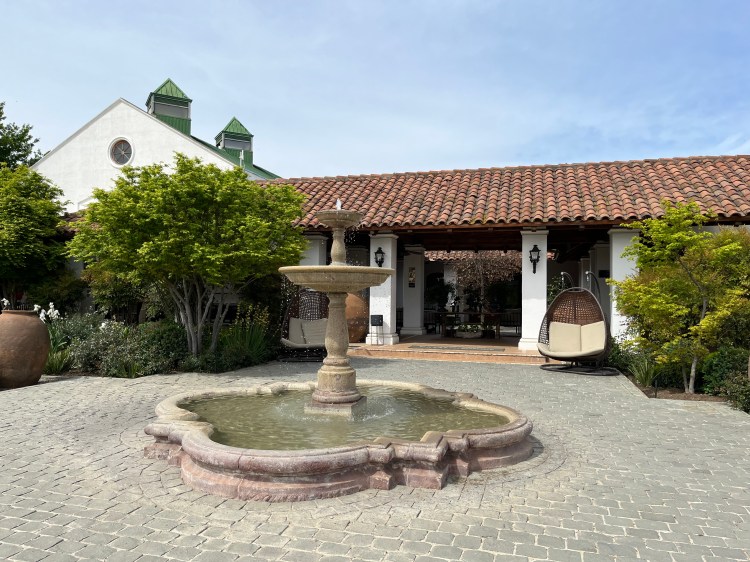
Mathias took us through to the steel tanks where the vinification process starts, then up to the fermentation tanks and out onto a balcony where you can see the entire horseshoe shape from above. There’s a nice fountain in the centre.
Upstairs
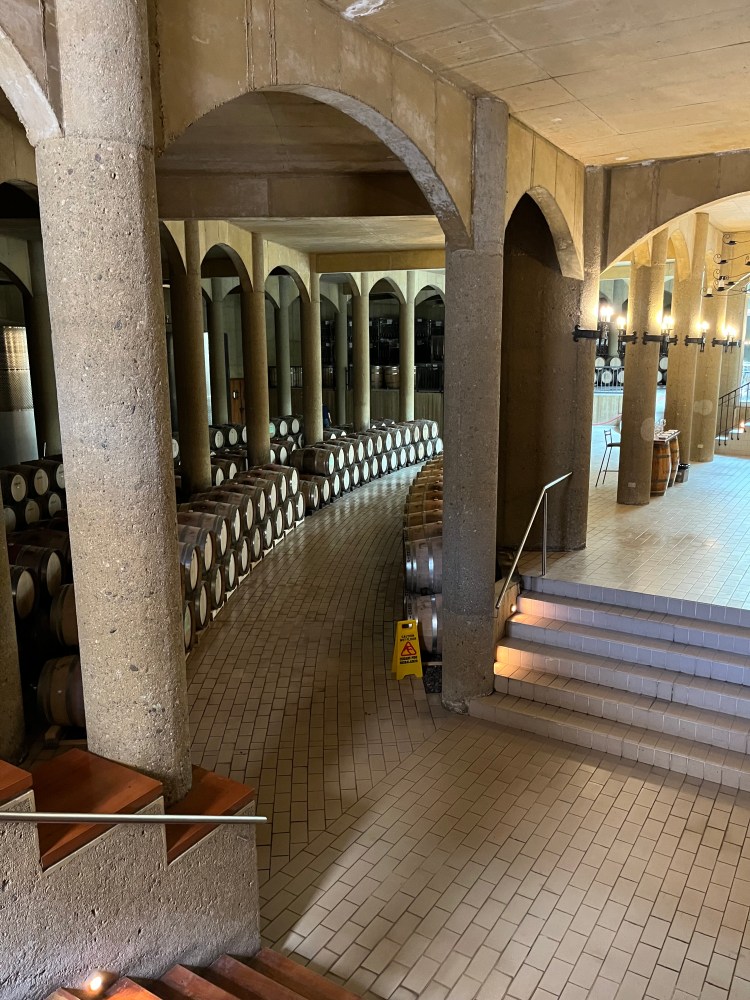
Next, we went down two flights of spiral staircases until we found ourselves in the striking aging cellar.
Aging cellar
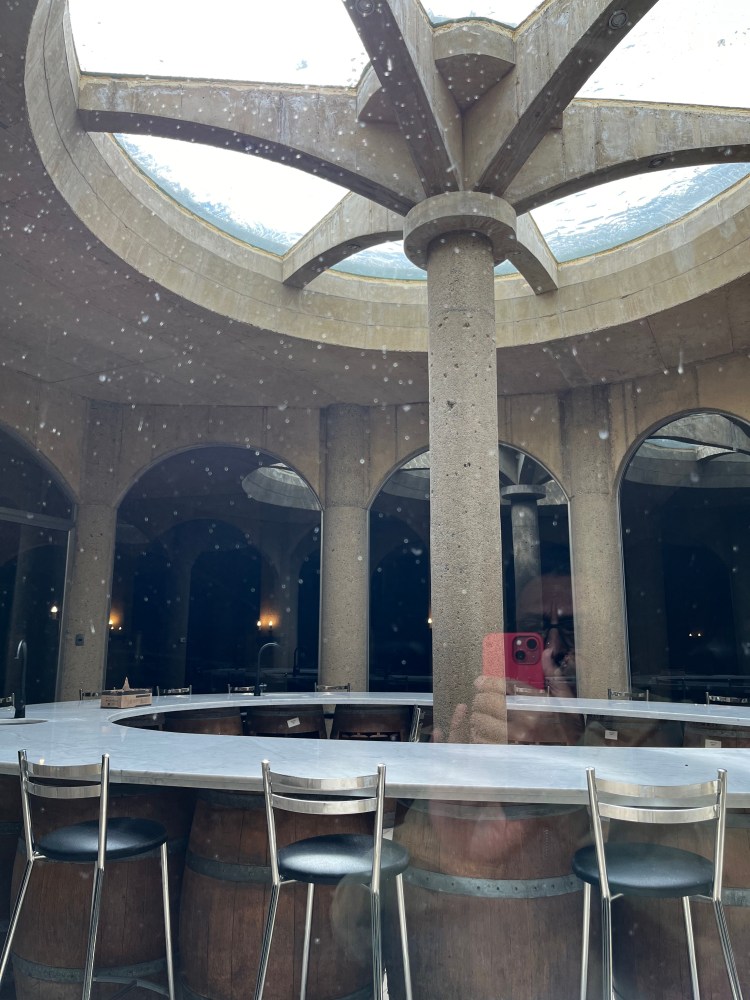
In the exact centre, there’s a tasting room, right under the fountain you can see up above.
Under the fountain
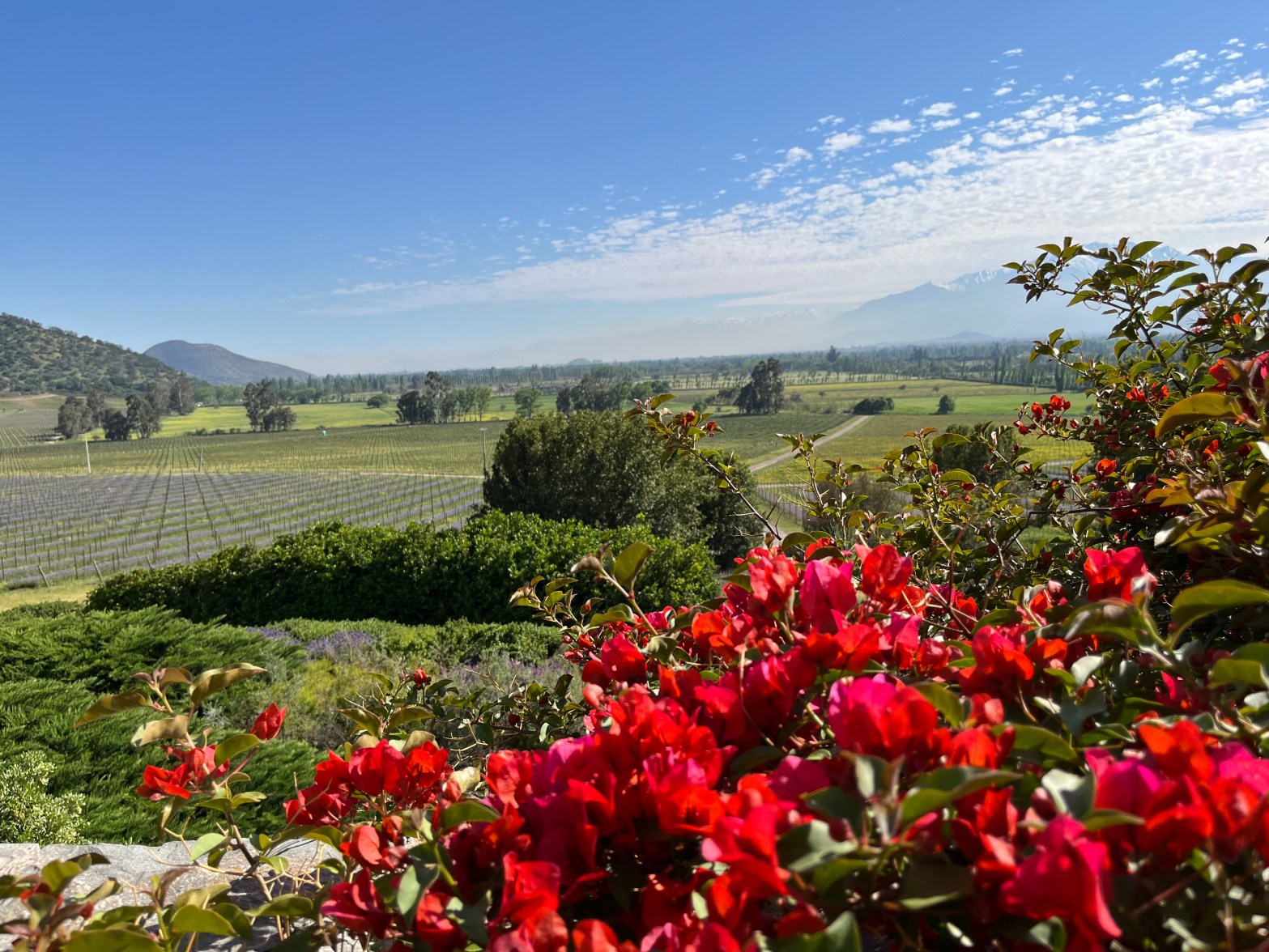
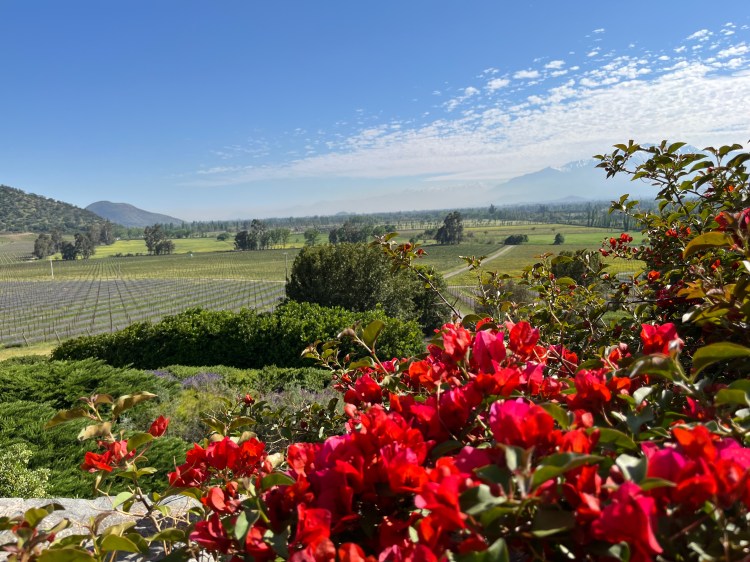
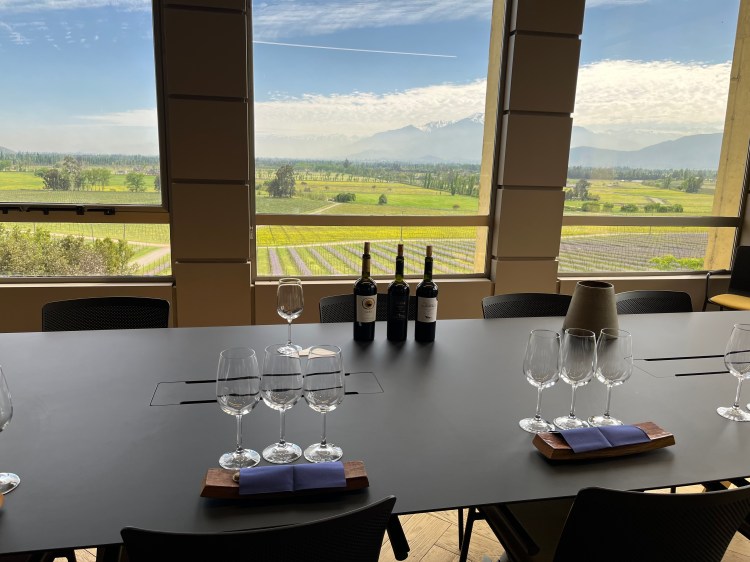
But we weren’t going to have our tasting there. Instead we were upstairs again, with a great view over the countryside.
Tasting room with a view
We started with a Sauvignon Blanc, which is made from grapes bought in from the Casablanca valley; they only grow red grapes in Maipo. Next came a Cabernet Sauvignon called Hussonet, the name of their most famous horse.
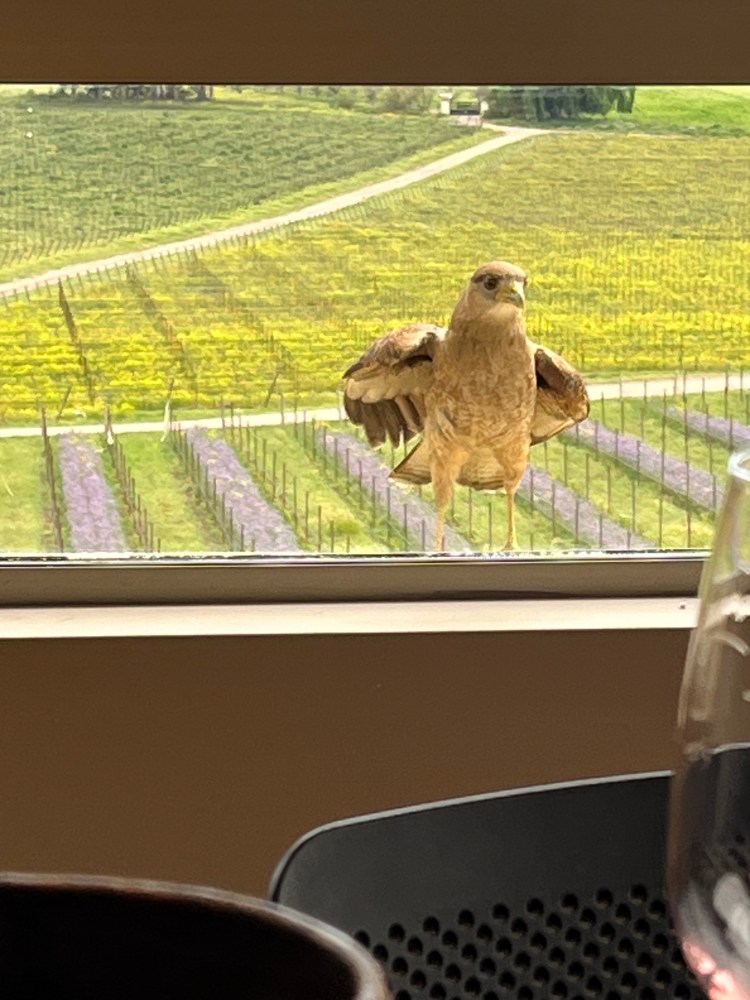
I’d seen some brown birds of prey flying around and one happened to land on a nearby tree, so I asked Mathias about them. They are Chimango or Cara Cara, a smaller relative of the Condor. Right on cue, one of them landed on the ledge outside and was closely followed by a second. They threw their heads back and started to howl, then kept fluttering at the windows. Apparently, they were fighting their own reflection.
Cara Cara looking for a fight
After the excitement, we continued with a Carménère called Ecral, after another horse and finally Albis, a Cabernet Sauvignon/Carménère blend, named after Antinori’s eldest daughter. Despite the last one being the most expensive, our votes went to the third one.
We then repaired to the restaurant, for a fine, three course meal with a wine flight.
After staggering out, we were supposed to do it all again at Concha y Toro, who make Casillero del Diablo. However, the tour was booked for 4:30 and they didn’t have an earlier one. Rather than hanging about for two hours, we decided to return to our hotel.
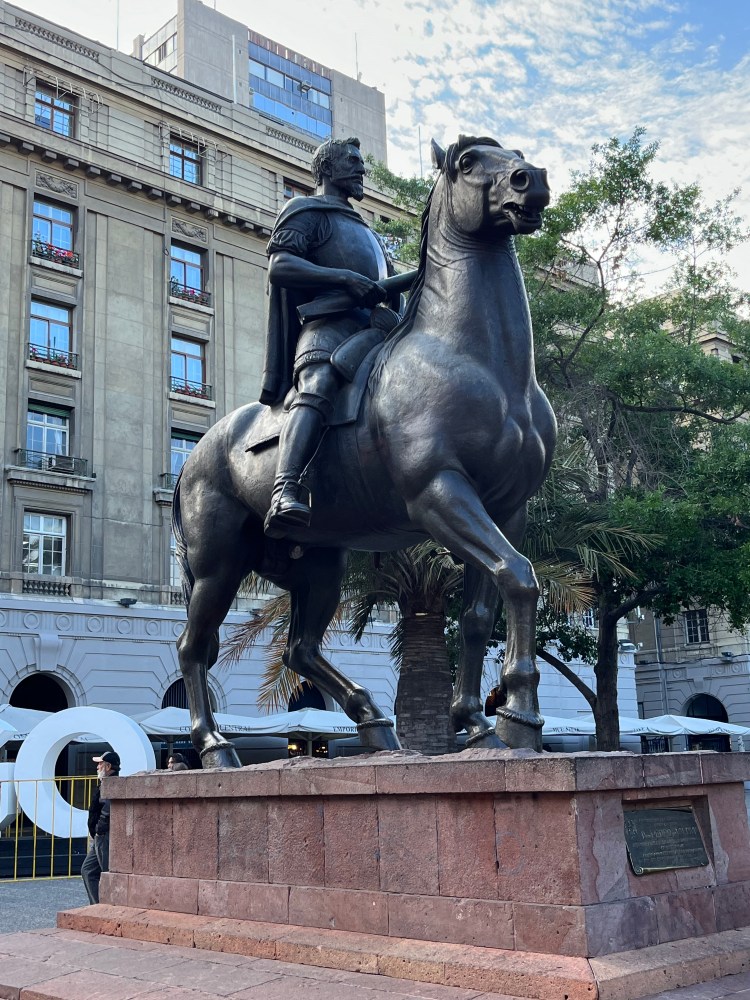
This morning Marco dropped us in the centre of Santiago with Valentina, for our tour of the city. First stop was the Plaza de Armas, which is surrounded on all four sides by large, imposing buildings. In one corner, there’s a statue of Pedro de Valdiva, the first governor of Chile during the Spanish rule.
Pedro de Validiva
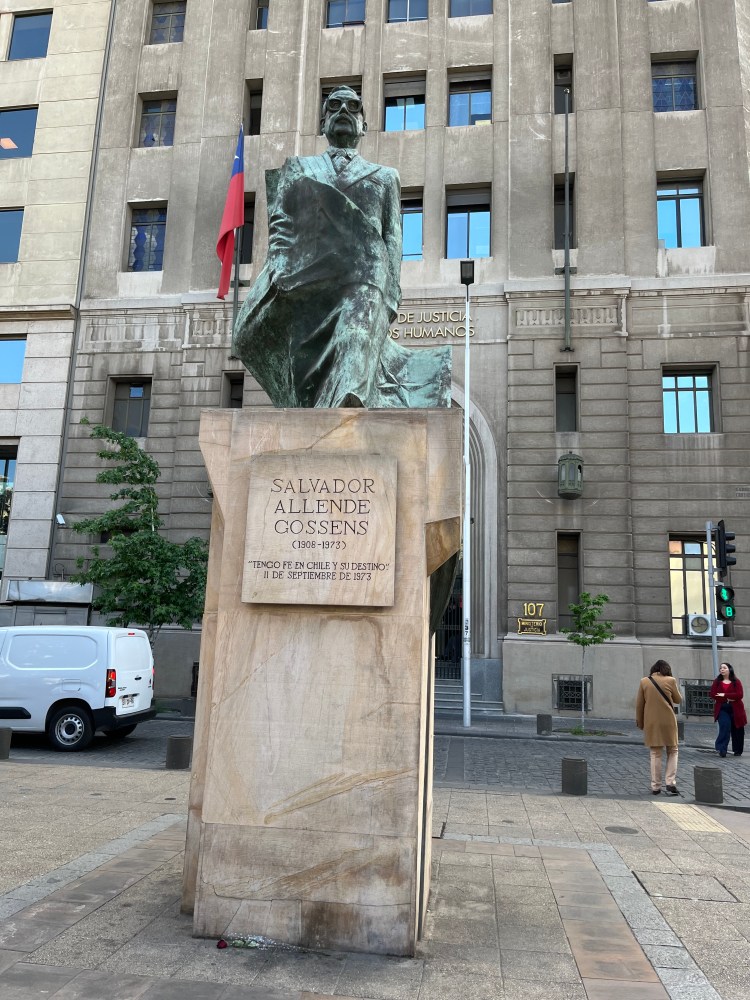
Moving along, we also saw the justice ministry and the presidential palace, which was getting ready for a charity concert. Nearby, there was a statue of Salvador Allende, the first socialist president in South America, who was ousted in a coup led by Augusto Pinochet.
Salvador Allende
We’d started quite early, and all around us there were smartly dressed people scurrying off to work. It’s been a long time since I saw so many business suits all in one place!
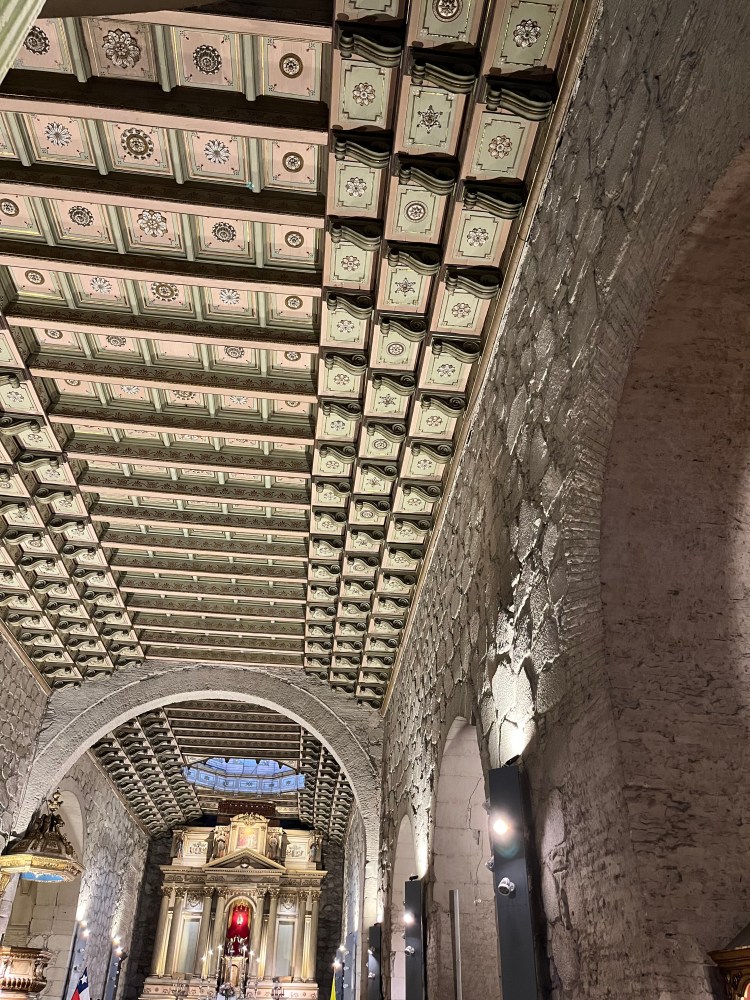
Next we visited San Francisco church, the oldest building in Santiago. Unlike other Spanish buildings, it has survived the numerous earthquakes, but then it was built on top of an Inca building.
Roof of San Francisco church
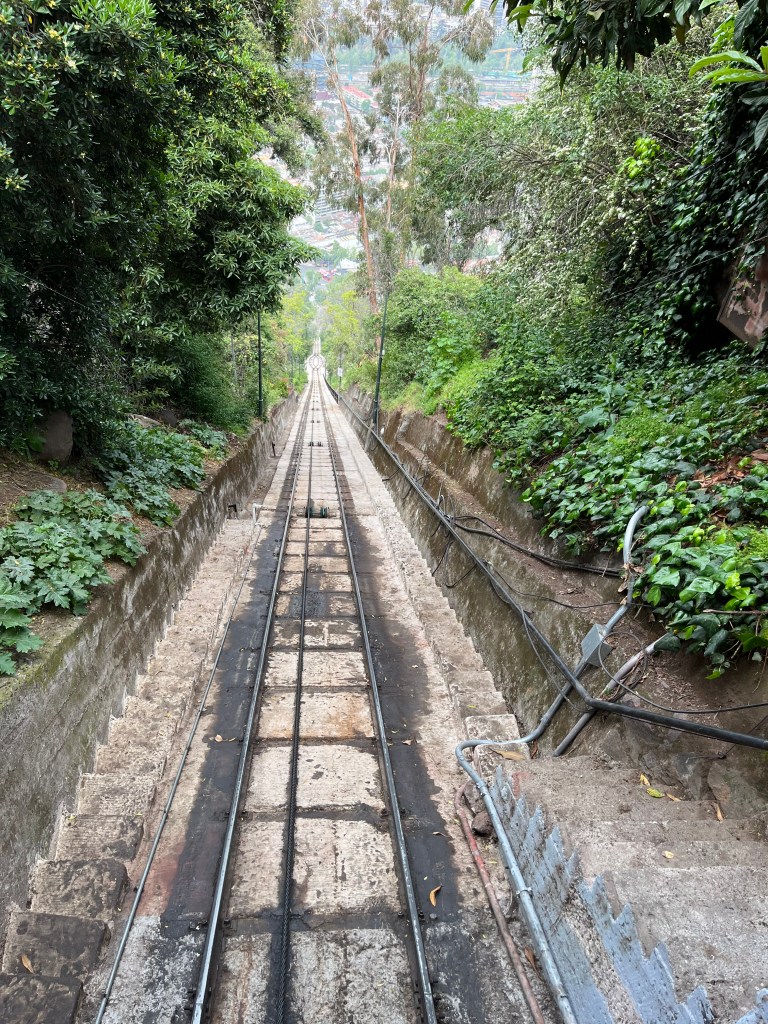
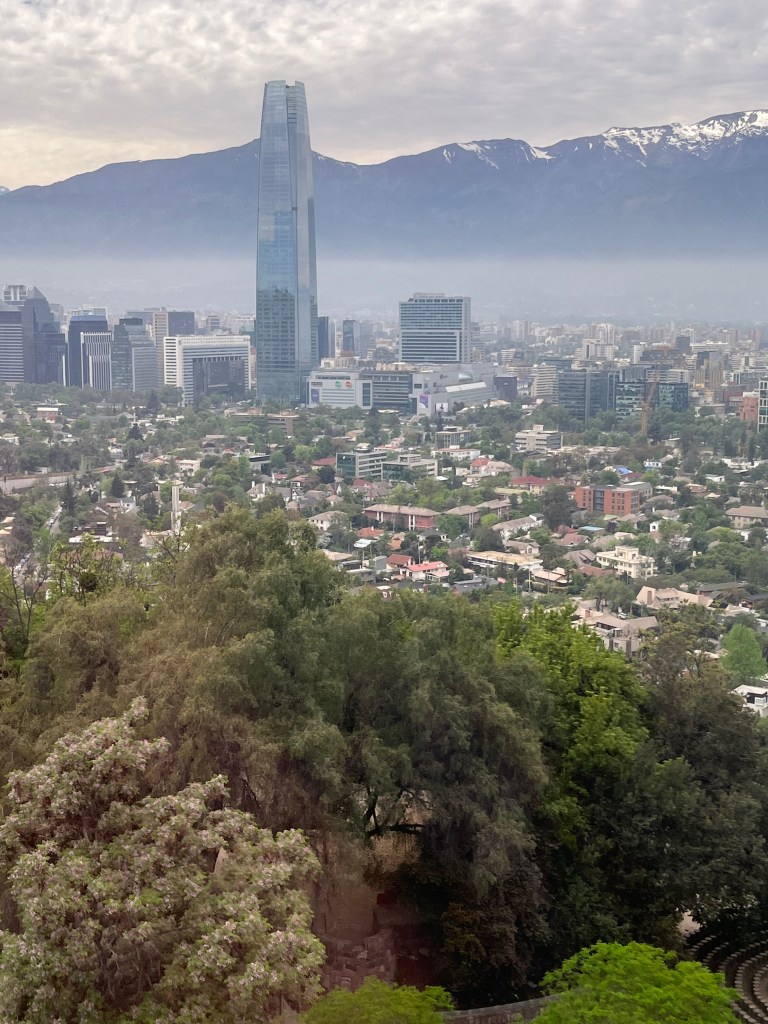
After a quick climb up Santa Lucia hill, we then found Marco again and zipped North to ride the funicular up San Cristóbal hill, where there are great views across the entire city. Unfortunately, there isn’t much else up there, unless you’re into expensive cheap souvenirs, so we walked across to the other side and came down by cable car.
FunicularGran Torre Santiago – South America’s tallest building
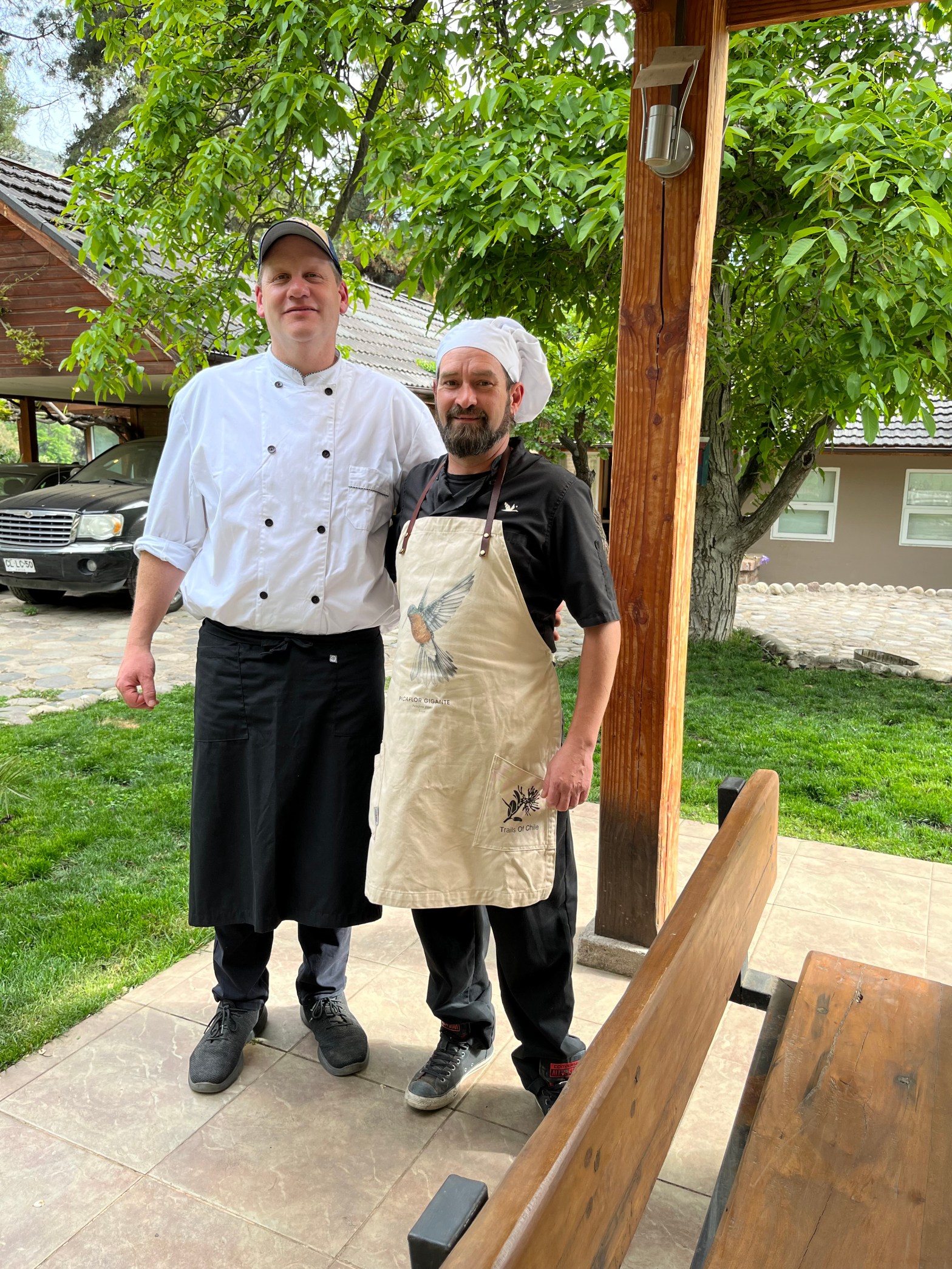
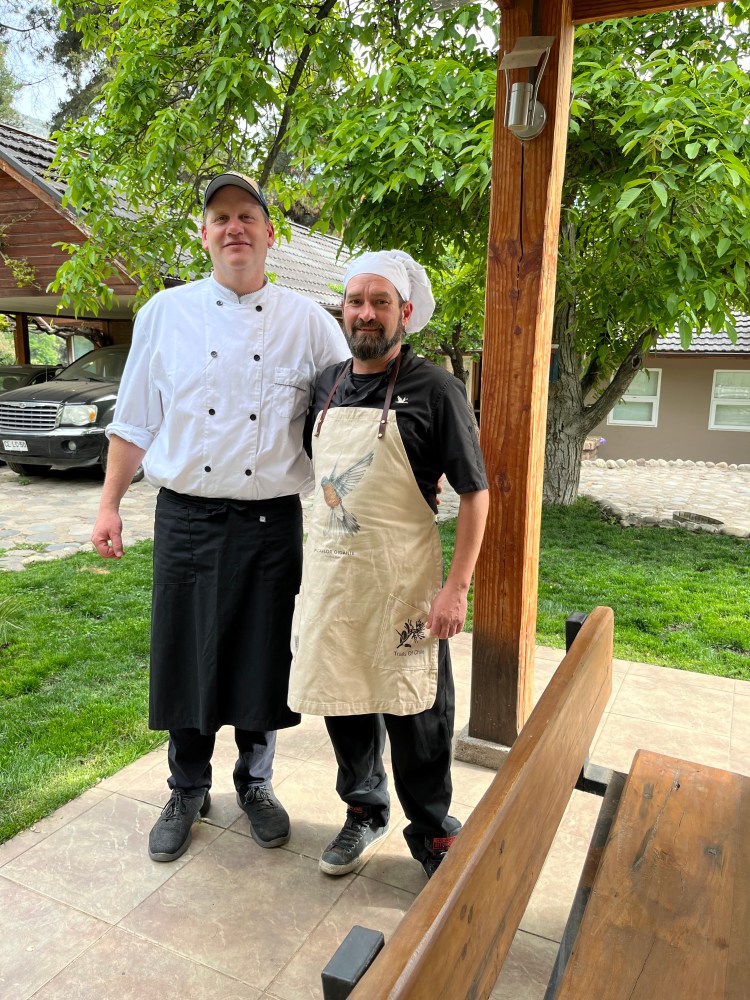
And that was the end of our city tour, but not the end of our day. We drove to the Northern outskirts of the city, nestling in the foothills of the Andes, for our Chilean cookery class with Roberto and Bruno.
Roberto and Bruno
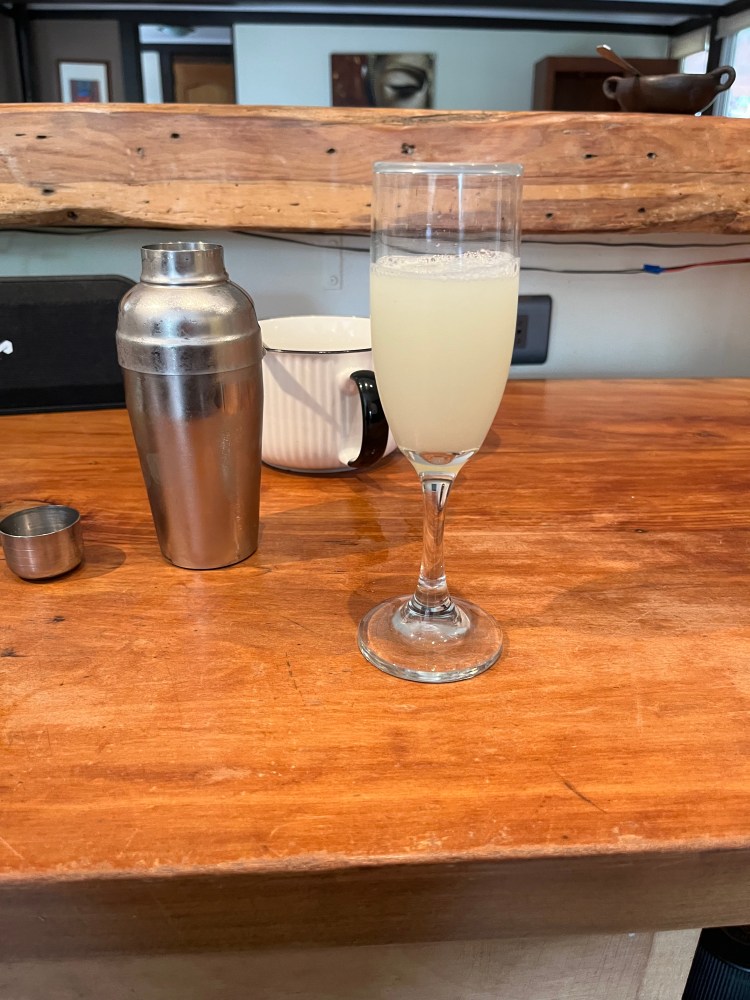
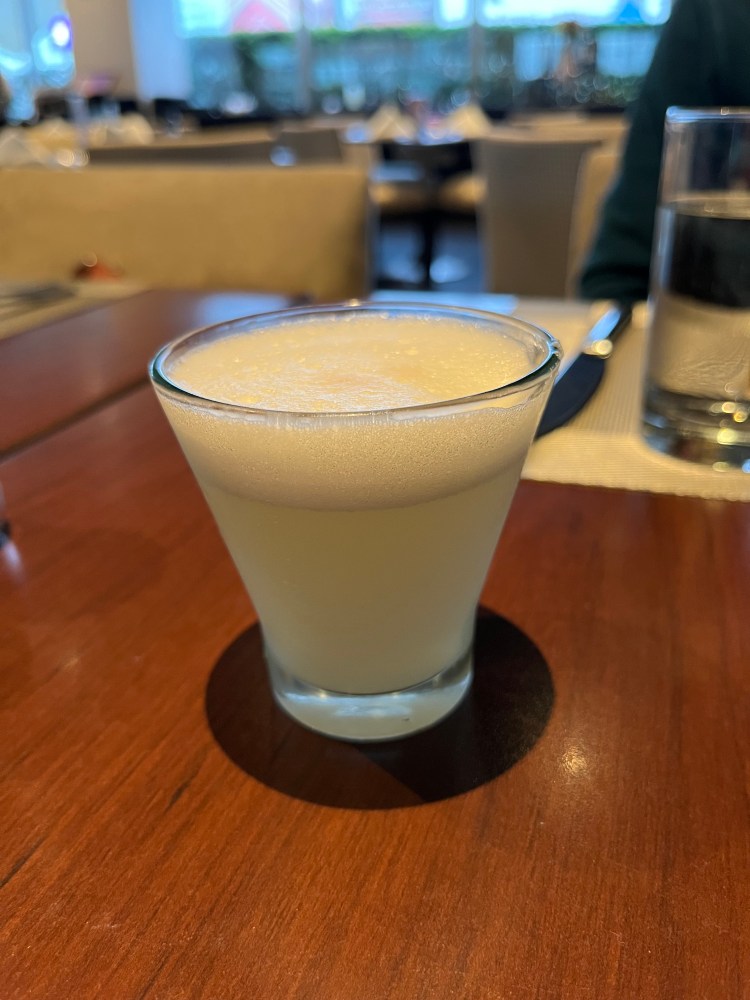
Having been suitably aproned, we started with a Pisco Sour. Apparently, Chilean Pisco isn’t the same as Peruvian Pisco, but after three measures of 48% alcohol spirit, who cares!
Pisco Sour
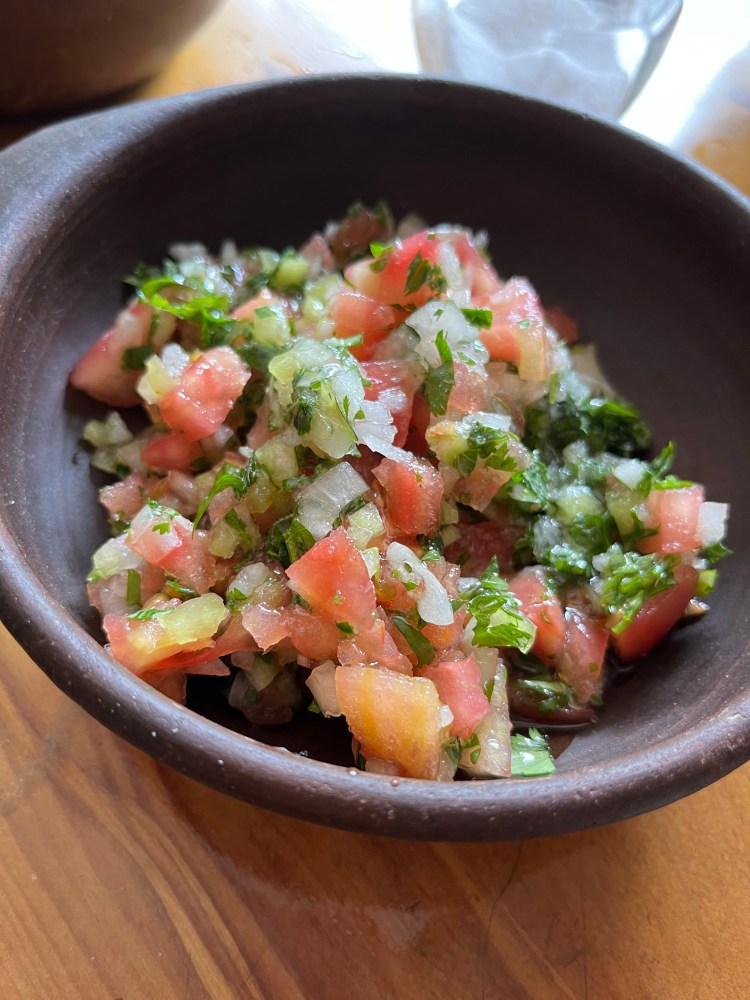
Next we moved on to an appetizer, which may be called Freire. We chopped tomatoes, coriander, chillies and onion and mixed them in a bowl with oil, salt and lemon. We spread a layer of the vegetables onto a roll and ate it. Delicious!
Freire
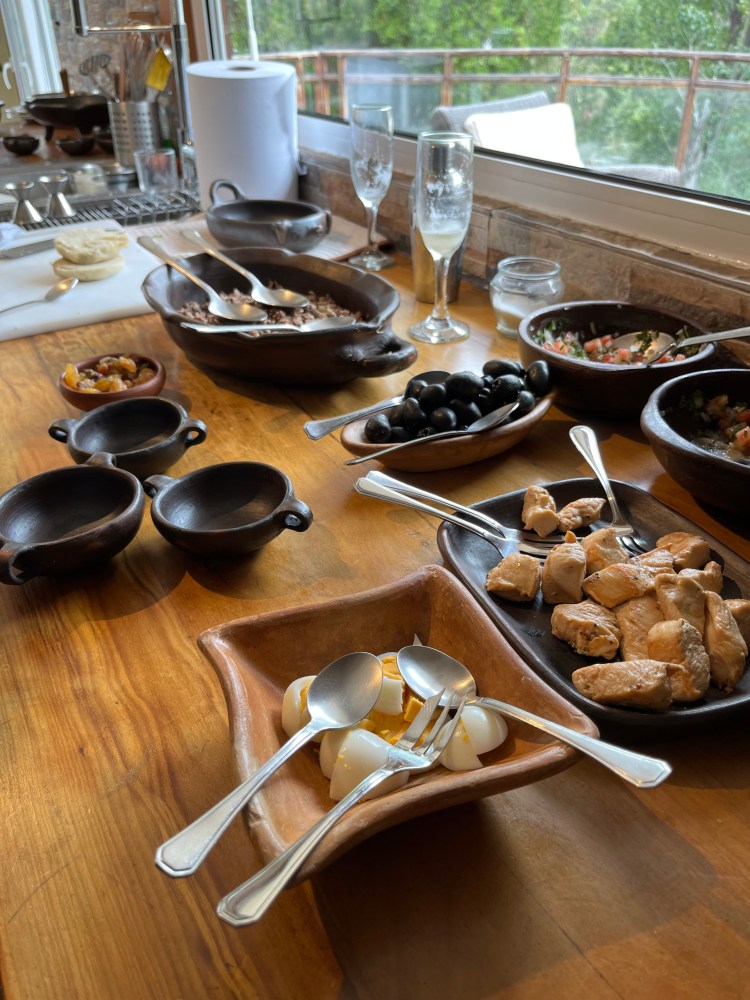
Pastel de Choclo, or corn cake, came next. We filled a little dish with mince beef, chicken, raisins, black olives and hard boiled eggs. We then topped this with a mashed sweetcorn and basil mix that had been cooked for three hours and popped it in the oven. I’ve no idea how long it cooked for, not just because of the Pisco but because we went outside to a table set for three in the sunshine. Poor old Bruno had to stay inside and mind the oven!
Makings for Pastel de Choclo
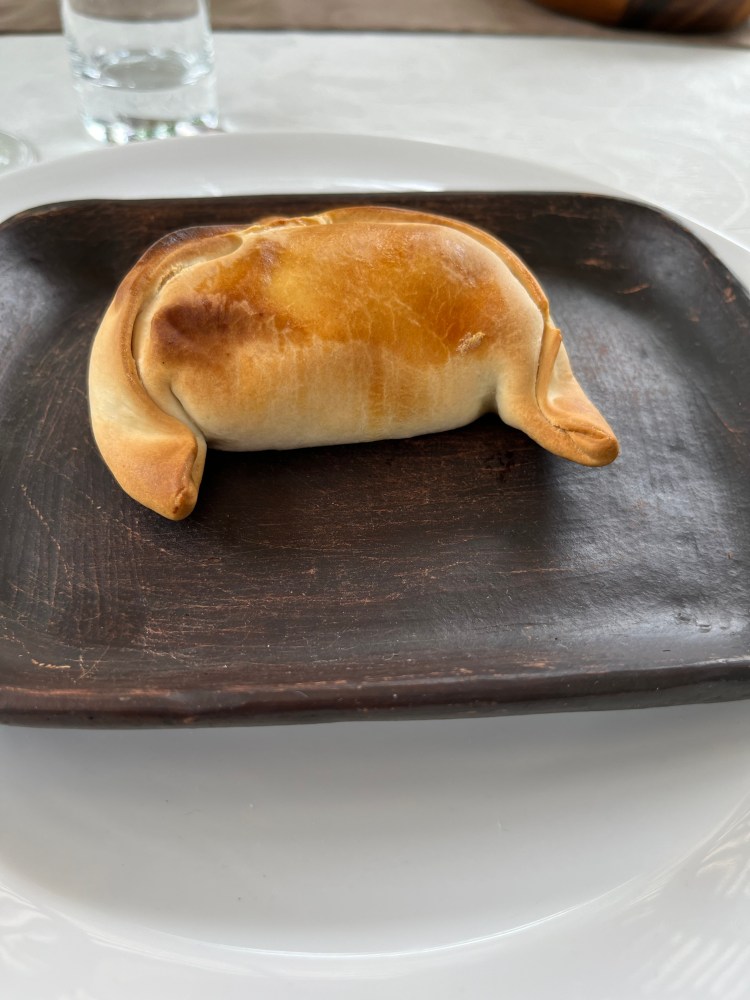
We were served empanadas, a bit like Cornish Pasties but tastier, along with a rather splendid 2014 Val Divieso Gran Reserva Shiraz. Roberto had made them this morning.
Empanada
Bruno then brought out our cooked Pastel de Choclo, which was also delicious.
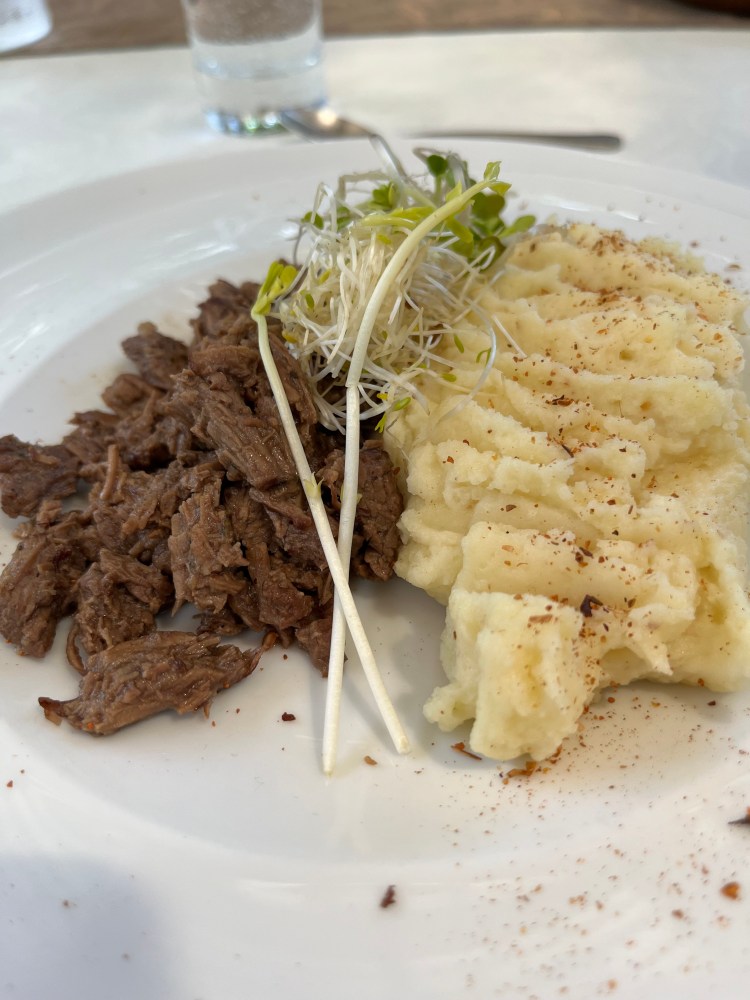
Our main course sounded like Chane Messala, but I have no idea of the spelling. This consisted of minced beef and mashed potato. It was served with another red wine, a Cousiňo-Macul Gran Reserva Cabernet Sauvignon. Not quite as good, but very palatable.
Meat and mashed potato
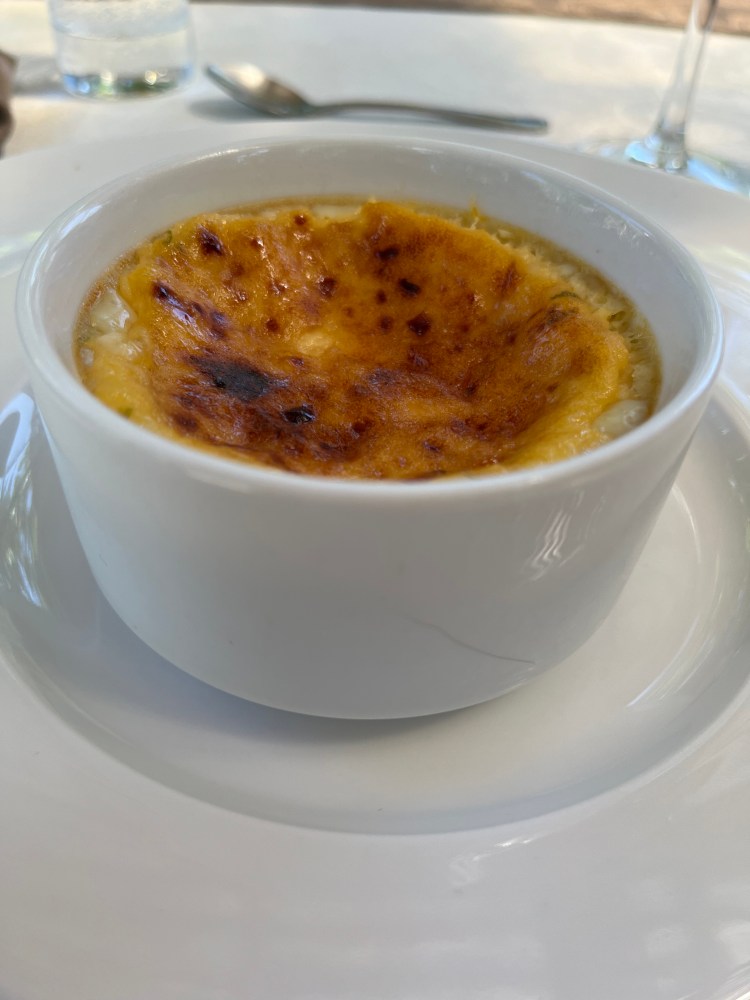
The dessert was Leche Assada, or baked milk. It’s a bit like crème caramel without the caramel.
Leche Assada
Bruno then joined us for our digestifs, the first being made with lúcuma, a South American fruit, which slipped down nicely. The second tasted like grappa or aviation fuel and I gave the third a miss.
During the meal we found out about Roberto and Bruno. As well as this cookery activity, which is fairly new for him, Roberto has a shop selling costumes; Halloween is coming up so the shop is busy at the moment. He has a 16 year old daughter who is training to represent Chile at Taekwondo in the 2028 Olympic Games in Los Angeles.
Bruno has lived in various places around the world and it was very easy to swap notes with him.
And then the doorbell rang! It was Marco come to take us back to the hotel before his Peugeot turned into a pumpkin.
This morning Valentina and Marco arrived to whisk us away from Valparaiso into the Casablanca valley. We were visiting one of the most successful Chilean wineries, Casas del Bosque.
Casas del Bosque
Our guide for the tour was Christopher, or you can call me Chris.
The vineyard started in 1993, when they planted some Chardonnay grapes. These days they grow a variety of grapes and can churn out up to 40,000 bottles per day. Not bad in 20 years.
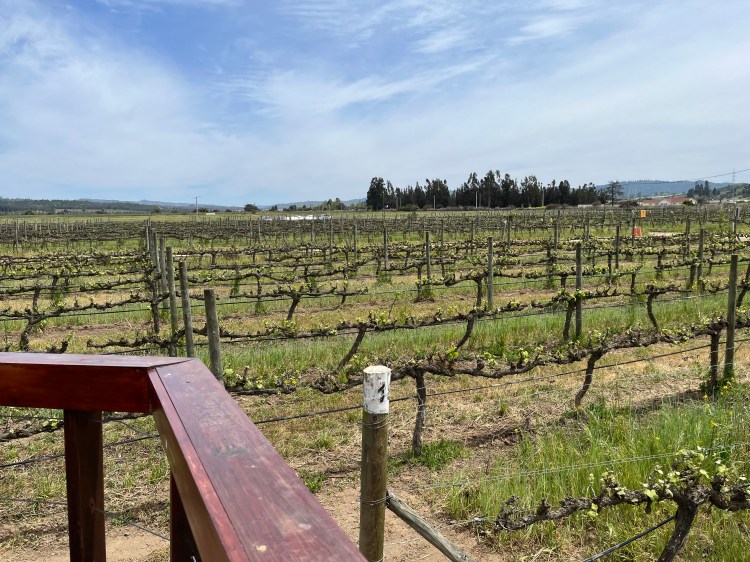
A few grapevines
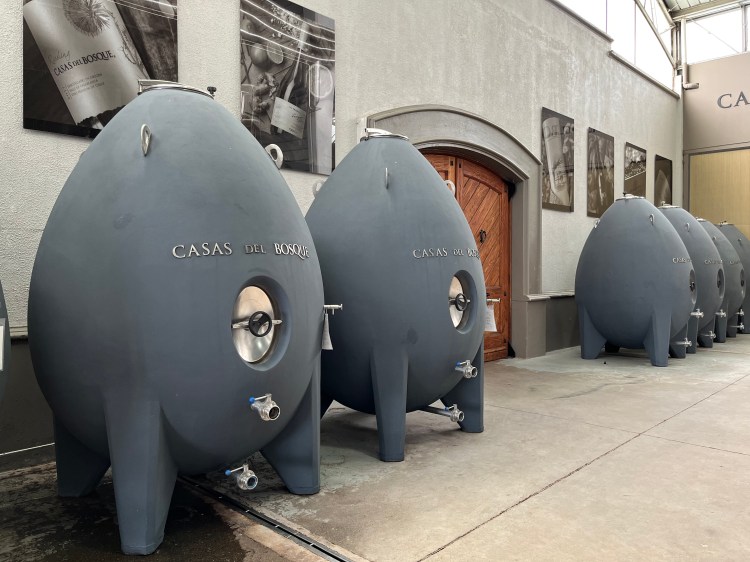
We had a quick tour of the production side, learning about the differences between stainless steel, concrete, wood and clay tanks, before sitting down in a rather plush tasting room.
Concrete tanks looking like Doctor Who villains
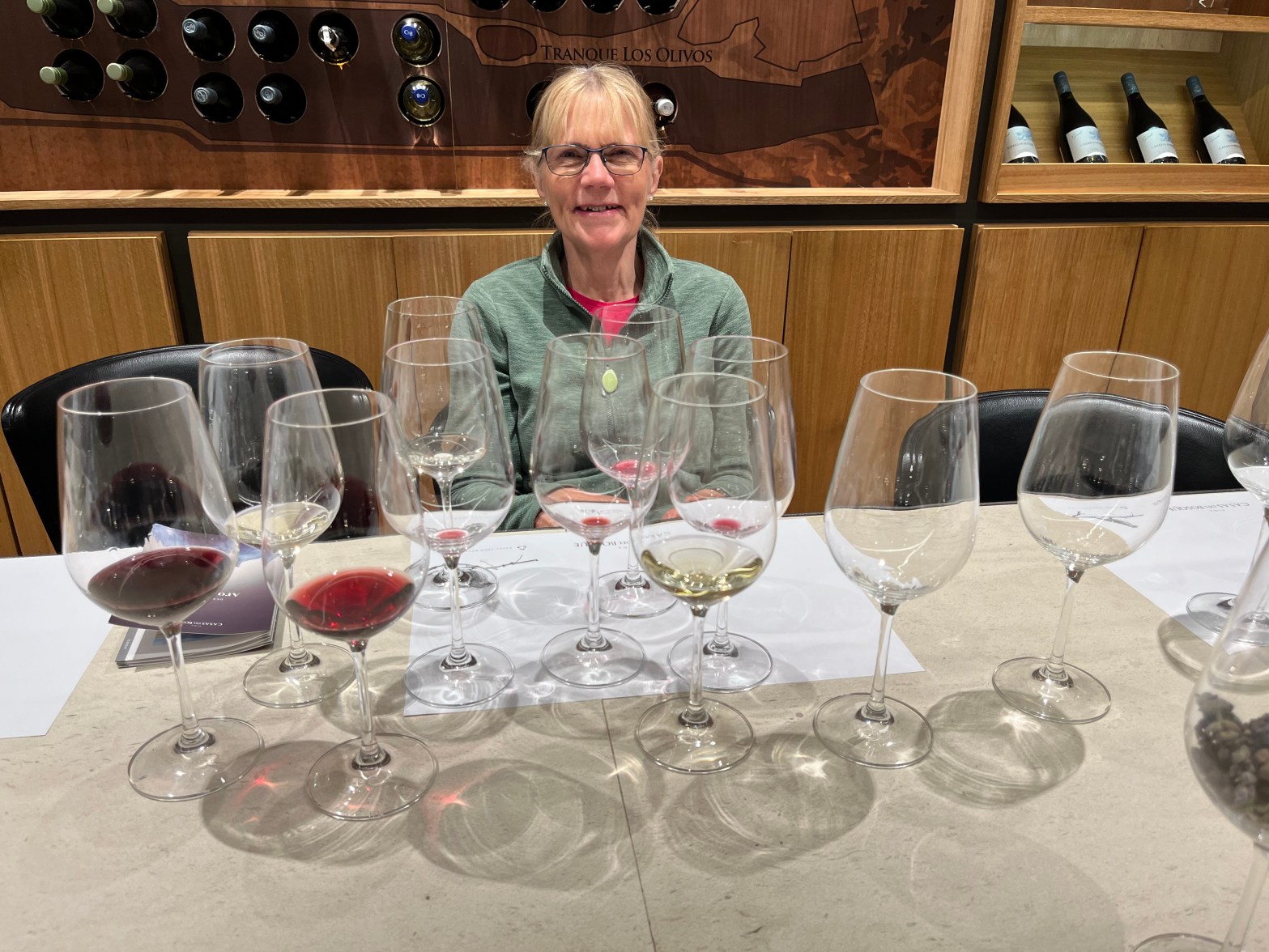
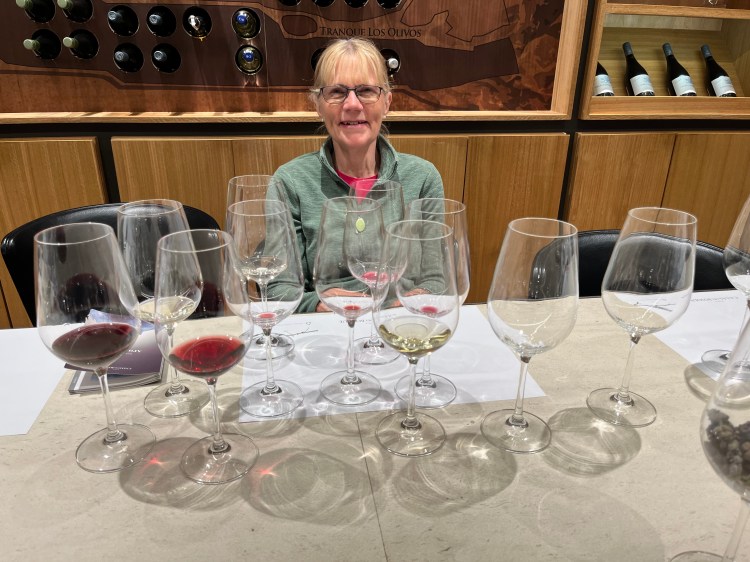
Our first tasting was their signature wine, a Sauvignon Blanc. This was followed by a Chardonnay, Pinot Noir and a Carmėnère, the grape Chile brought back to the world 150 years after it was considered extinct.
Finally, we were given a very special Private reserve Cabernet Sauvignon 2020, a wine that is only produced when the vintner feels like it. Personally, I preferred the Carmėnère!
Diane after her tastings
After that, we hit the road again to drive to Santiago, where we’re now ensconced in our room at the Singular Hotel.
Yesterday we flew back from Atacama to Santiago and then drove to Valparaiso. After a long day, all we wanted to do was eat and sleep.
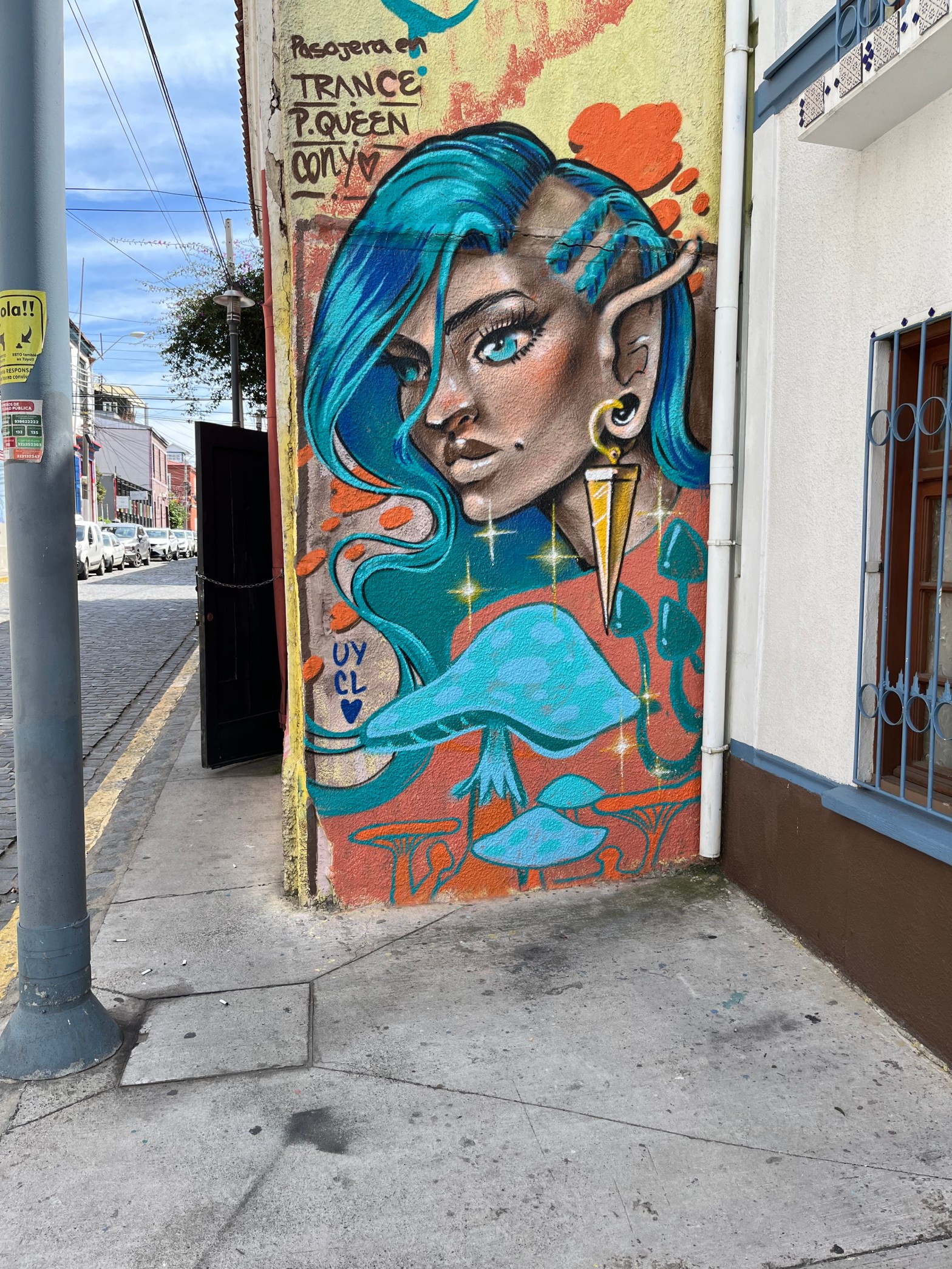
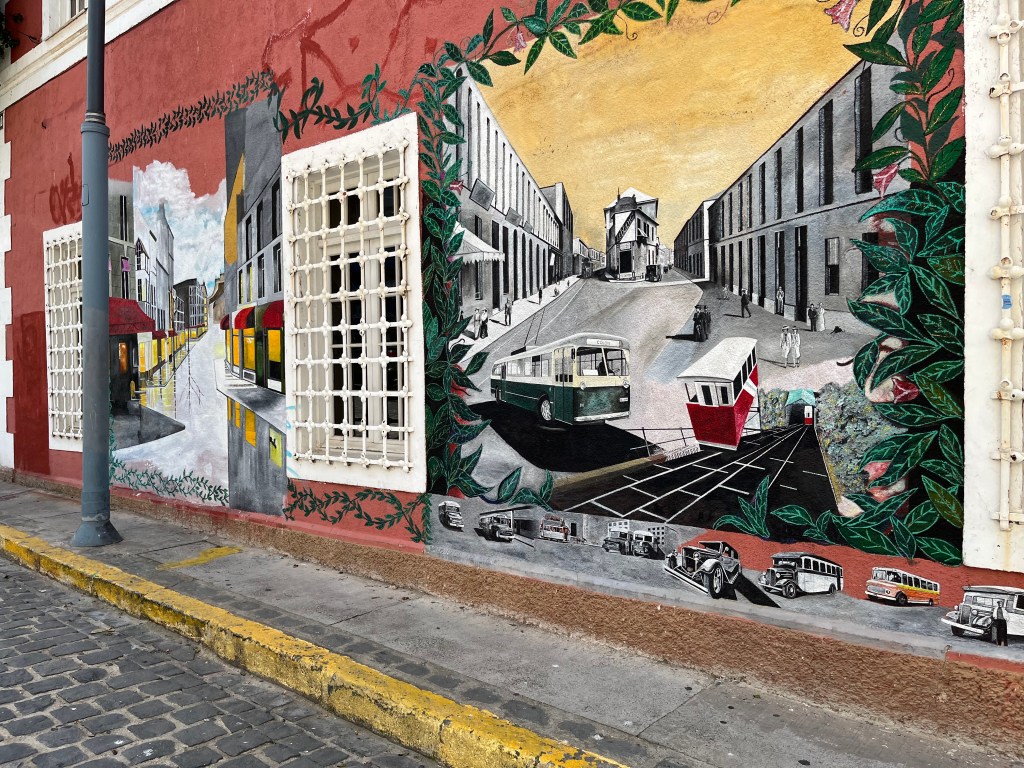
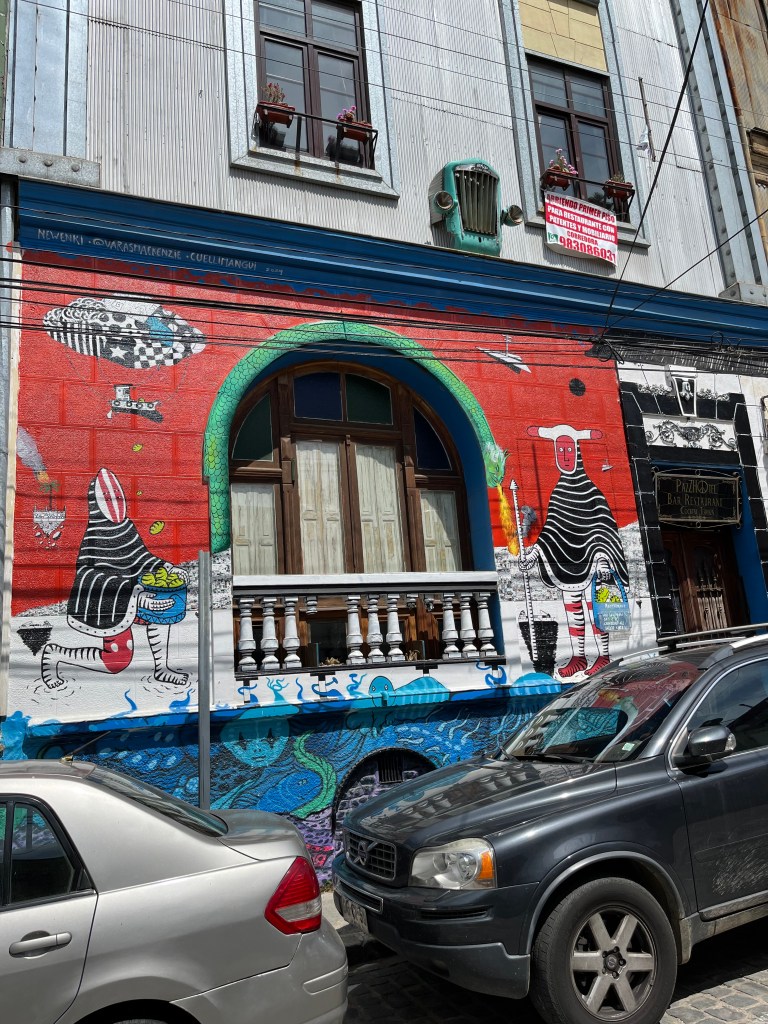
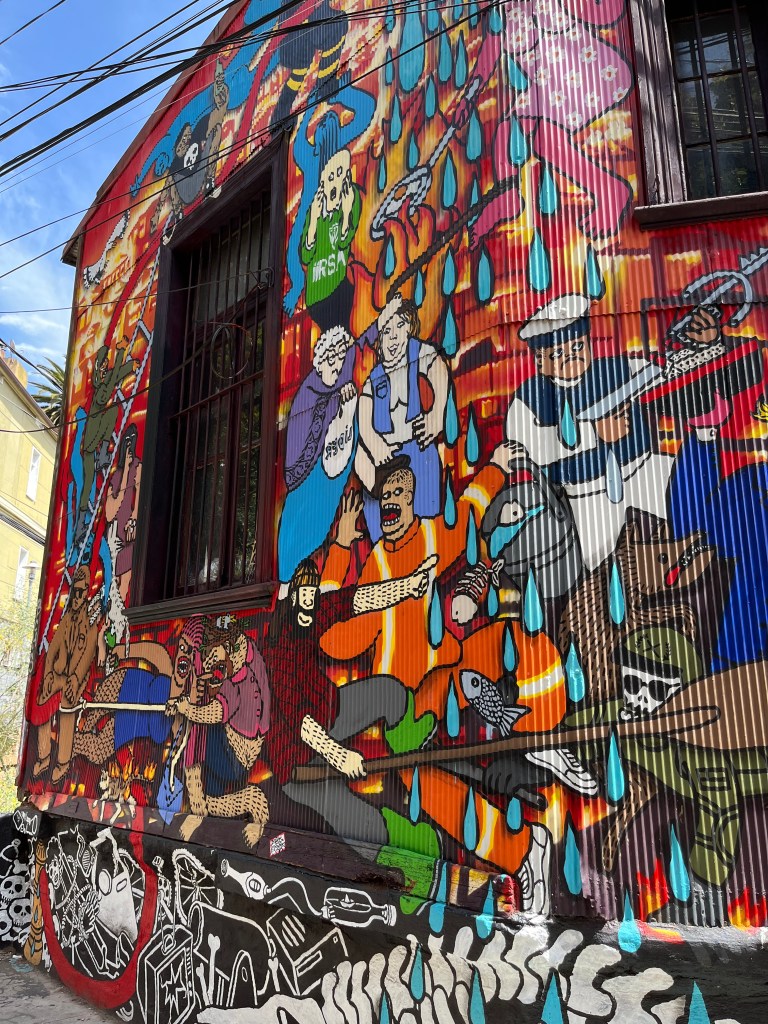
This morning we met Magdalena, our guide for Valparaiso. The first thing you notice about the city is the colours. A lot of the houses are painted in bright colours and wherever you look there is street art. A lot of it is commissioned by building owners in an attempt to keep graffiti off their walls, and many of the artists are well known and make a living doing it.
Street artStreet art
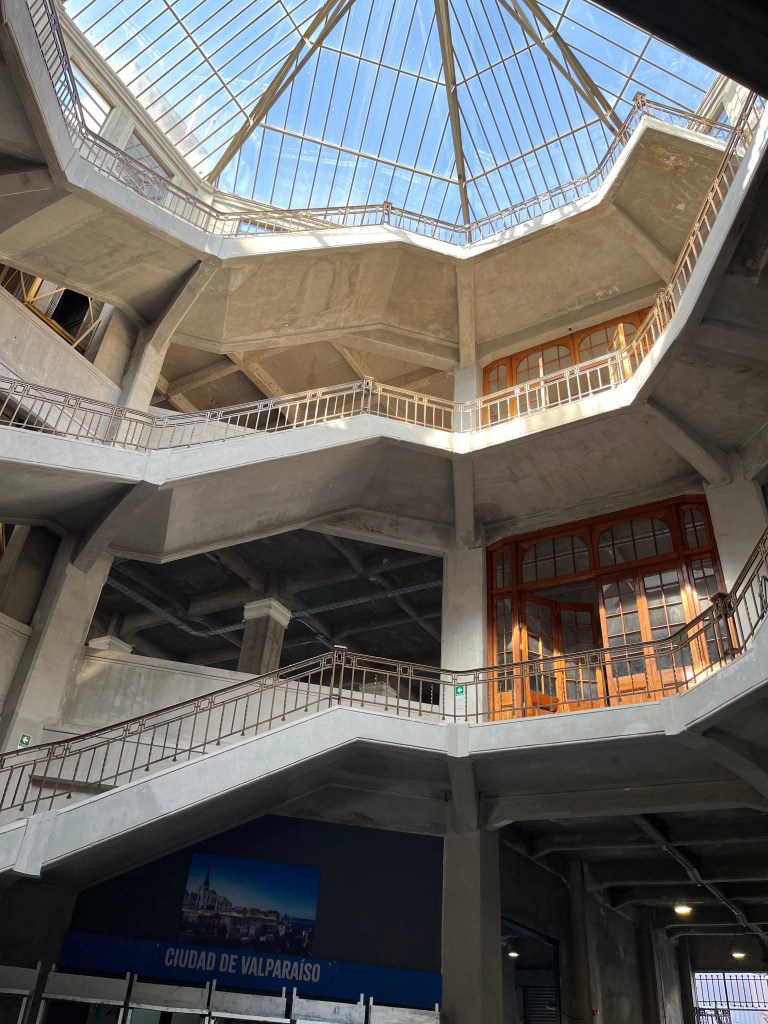
We started at the Puerto Mercado, a large, five storey building. It was closed in 2010 after being damaged in an earthquake. Just as it was about to open, COVID happened, so the building remained closed for a further two years. In the meantime, the traders had moved to other venues, so now there are only a few stalls in use.
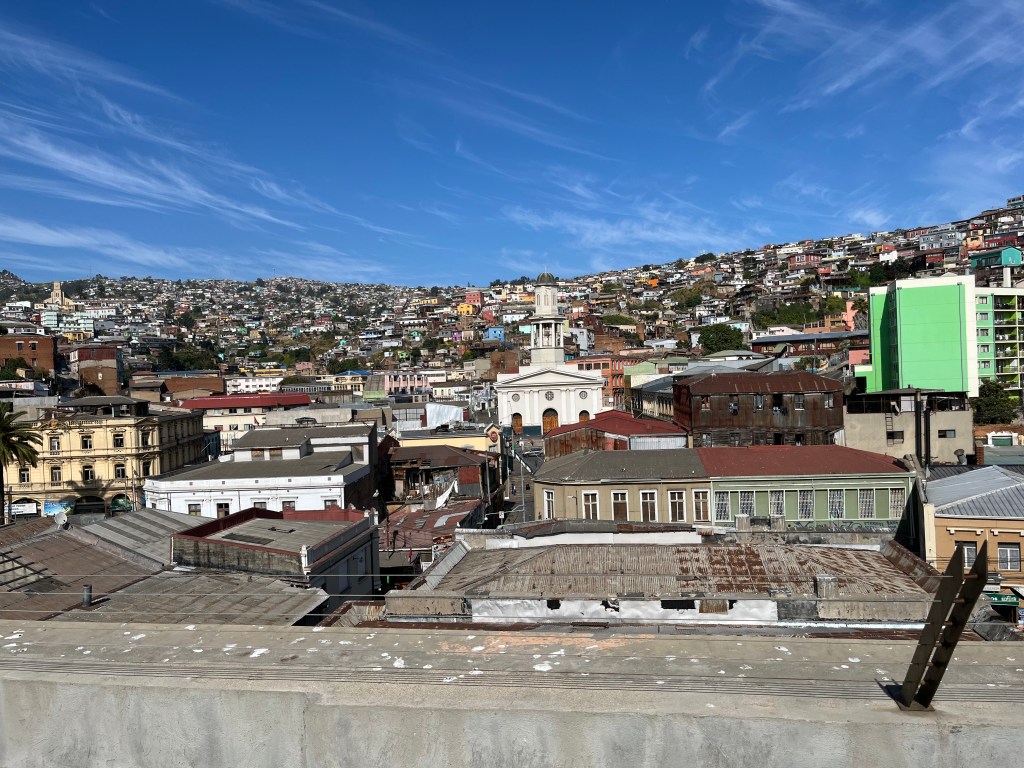
The reason we went there despite it being empty is that we could get up onto the roof, from where there are great views of Valparaiso. Unlike most cities in South America, Valparaiso was unplanned. Instead of the traditional Spanish layout of a square and streets radiating out from it, it is a complete hotch potch. The city is built on 45 hills, with a very small patch of flat space fronting the harbour; most of this land has been reclaimed over the last 100 years or so. During the 19th century, there was mass immigration from Europe, mainly UK, Germany and Italy. As the population increased, the city simply expanded onto the hillsides in an uncontrolled way, each nation having its own neighbourhood.
Inside the port marketValparaiso from the rooftop
A majority of the houses are built with a timber frame clad in corrugated iron painted in bright colours and filled with adobe blocks. This makes them more resistant to earthquakes.
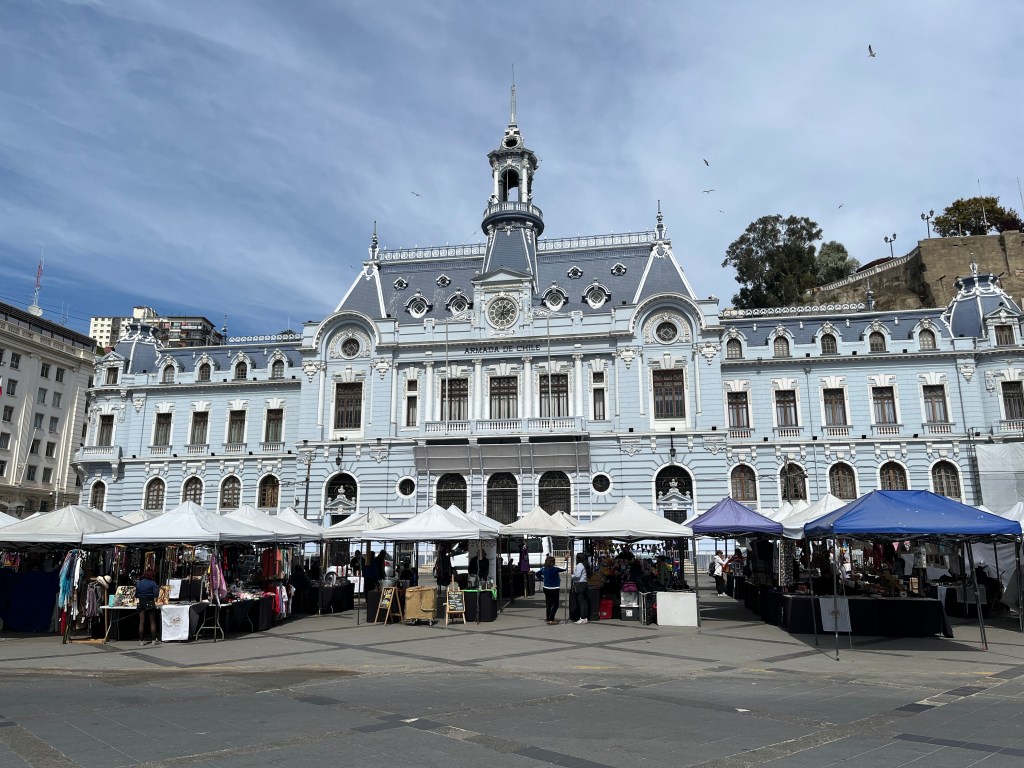
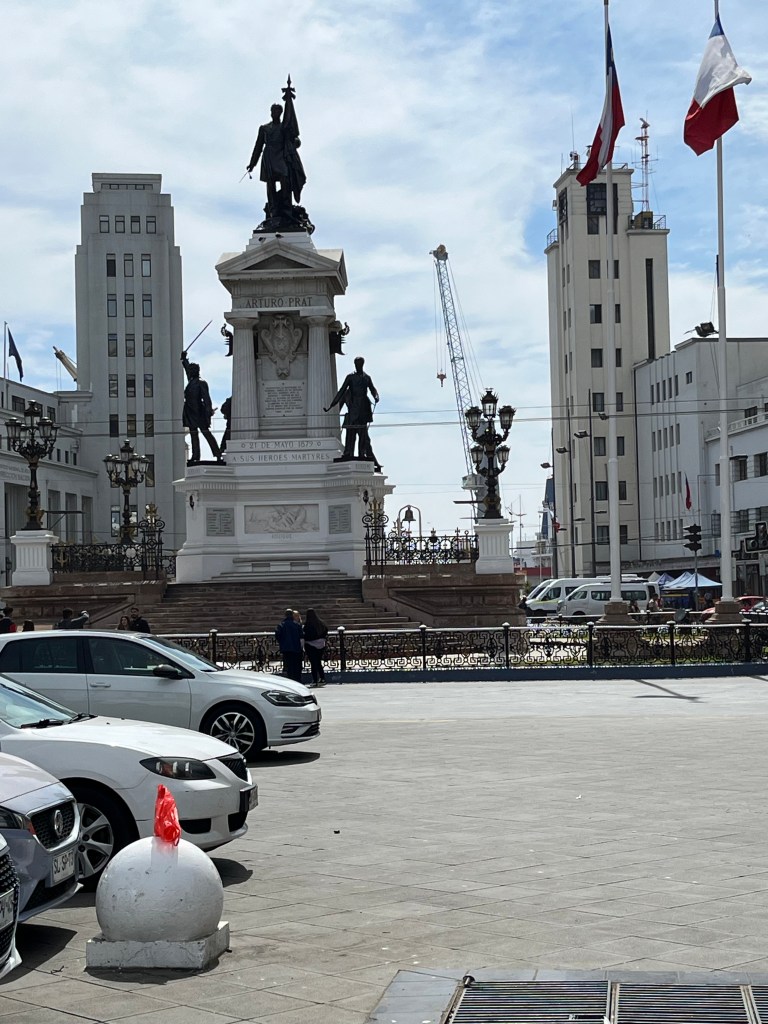
From the market, we walked along some of the flat part of the city, through the financial district to the Plaza Sotomayor, one side of which is home to the Navy headquarters. Opposite that is a monument to the people who fought in the Pacific War, between Chile and Peru and Bolivia, which established Chile’s modern borders.
Navy headquartersPacific War monument
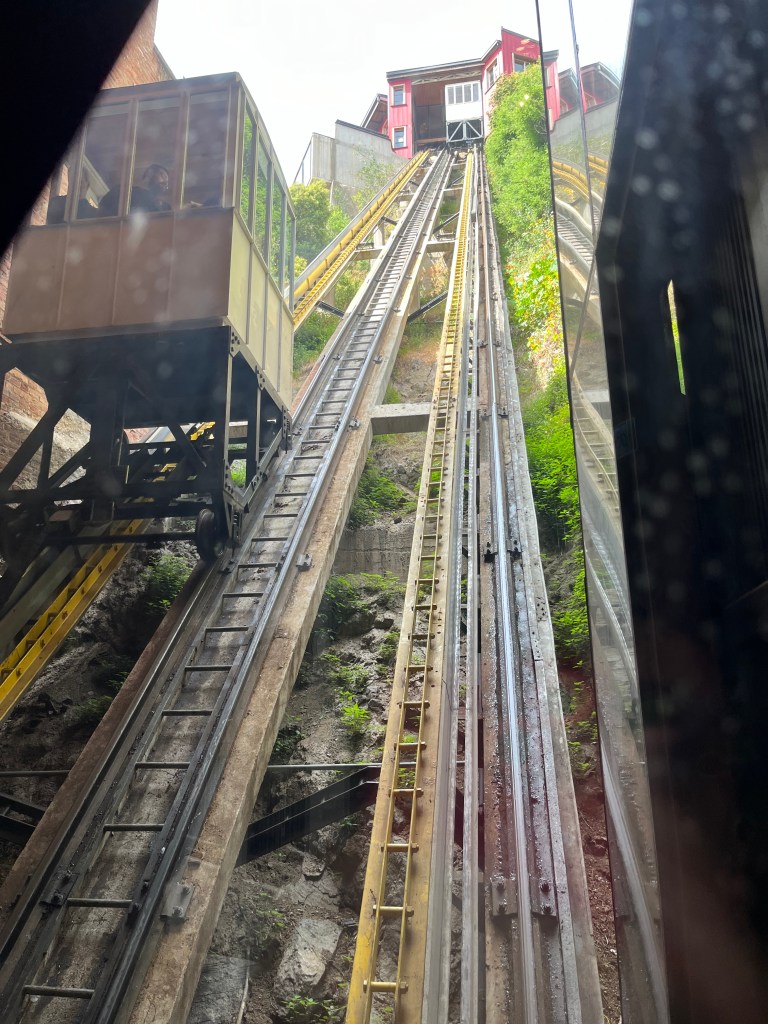
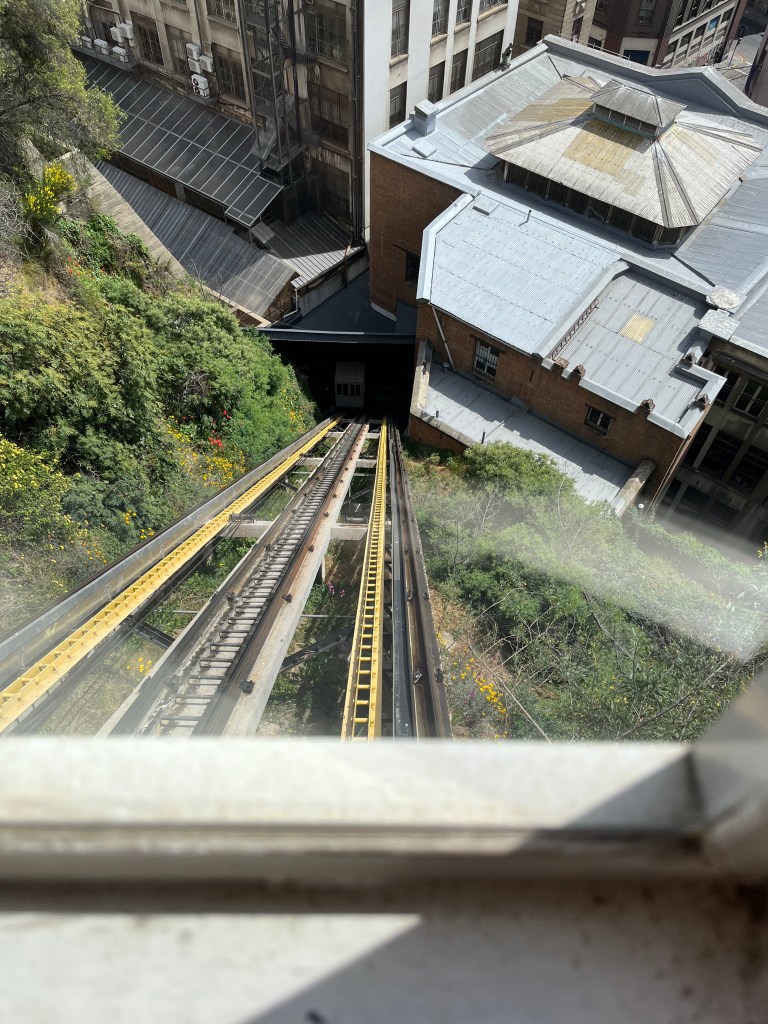
It also contains America’s first fire station, which is manned entirely by volunteers. Even today, all the fire stations in Valparaiso are manned by volunteers. Further on, we came to the Concepcion funicular, built in 1883 and still using the original mechanism, although it is now powered by electricity. At one time there were around 30 funiculars, but now only 12 remain in operation. As part of being declared a UNESCO site, Valparaiso has pledged to maintain these as important cultural assets.
Concepcion funicularConcepcion funicular
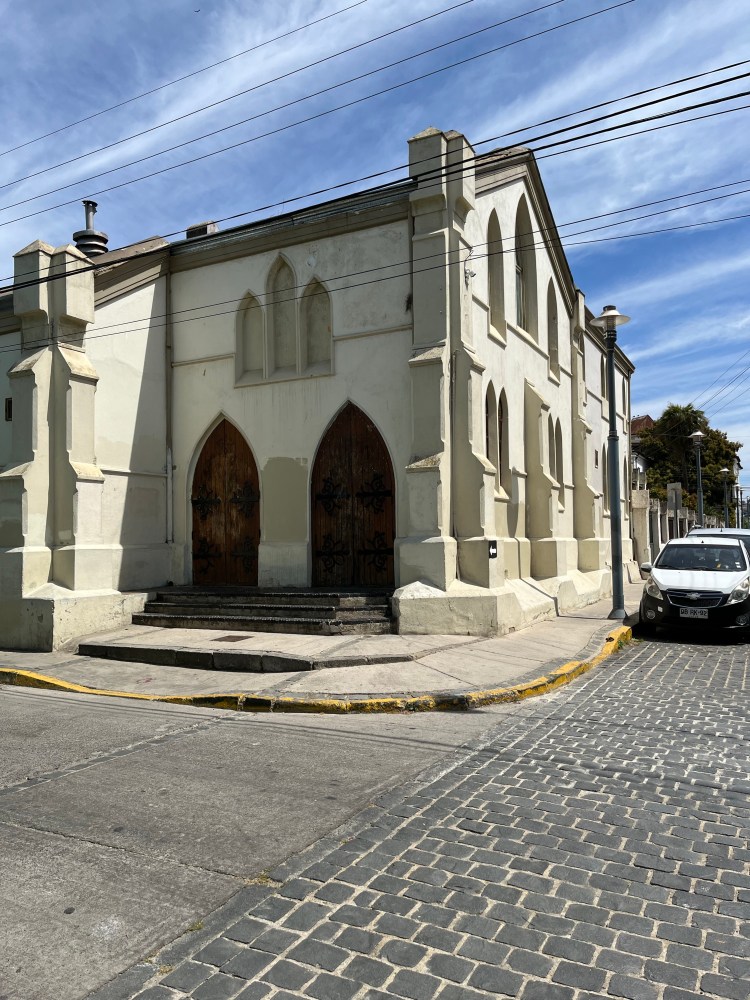
At the top, we strolled through the German and British sectors and popped into the Anglican Church for an organ recital. The music was so sombre that we quickly popped out again!
Anglican church
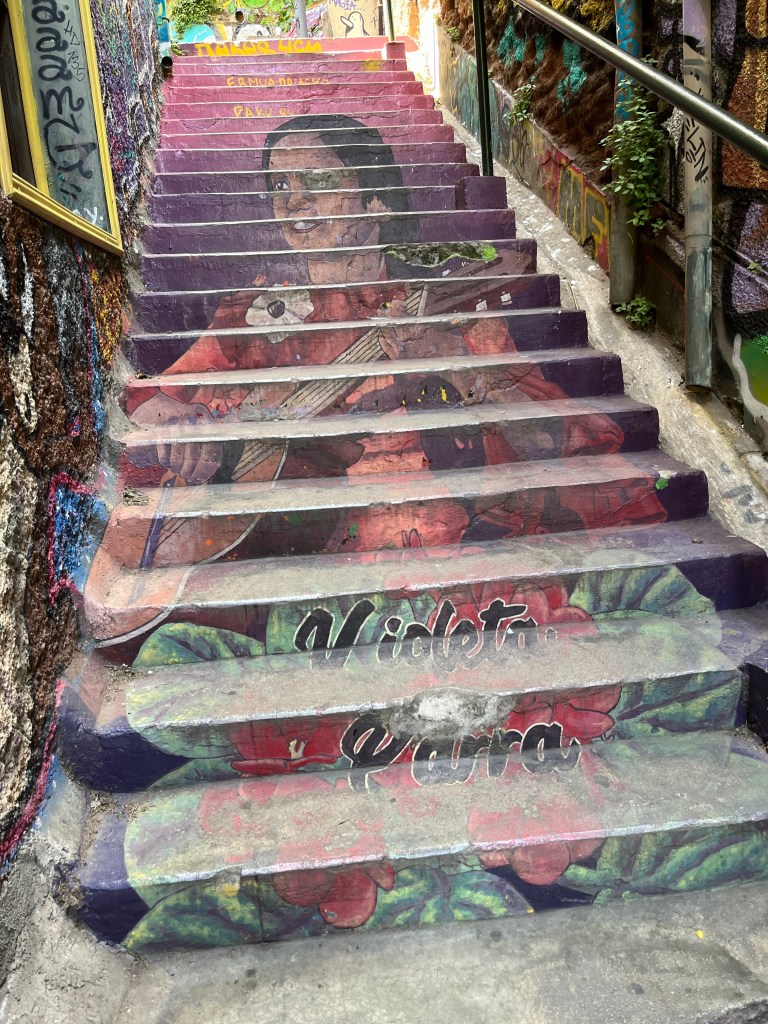
We also popped into a little art gallery selling local contemporary art, some of which is quite unique. And if you step onto the terrace at the back and look down, there’s a piece of street art created for the gallery owner that you can’t see from anywhere else.
Stair artStreet art
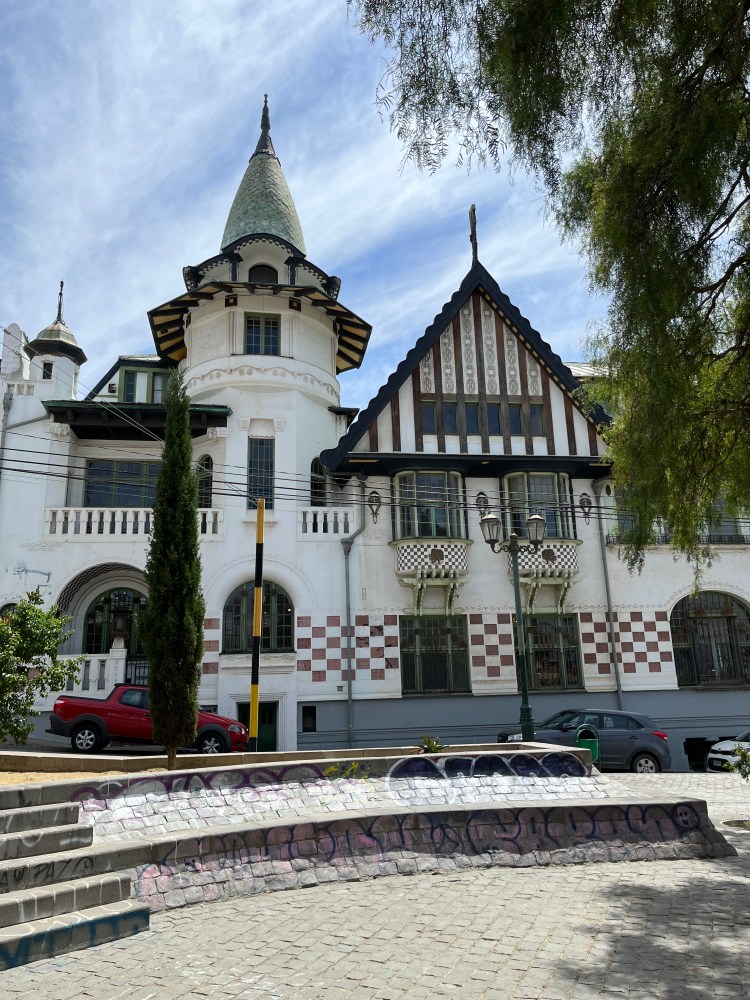
Our last stop was at the Palacio Baburizza, a beautiful Italian-style building that houses the museum of fine arts. Built by Italian businessman Ottorino Zanelli, it was acquired on his death by Yugoslavian Pascual Baburizza, who lived there and had a large collection of European artworks. When he died, he left the building and his collection to the city. The original collection is now housed on the ground floor; the next two floors contain Chilean art that has since been acquired by the museum.
Palacio Baburizza
Back at the hotel, we said goodbye to Magdalena and then wandered off to look for something to eat. By then it was 3:30 and we hadn’t eaten since breakfast. We found a lovely seafood restaurant, Gente de Mar, or People of the Sea, whose motto is “Time to relax, this is not fast food”. So we relaxed in the sunshine and explored some Chilean salmon dishes and deserts!
Barbara picked us up after breakfast and we set out to the South, heading for the highland lagoons. At the highest point in our journey we’d be at 4,200 metres.
We stopped at Socaire, where Barbara had to buy tickets for all the places we were visiting. This was once a little village where farmers spent the summer months with their flocks. Now it’s turning into another tourist attraction.
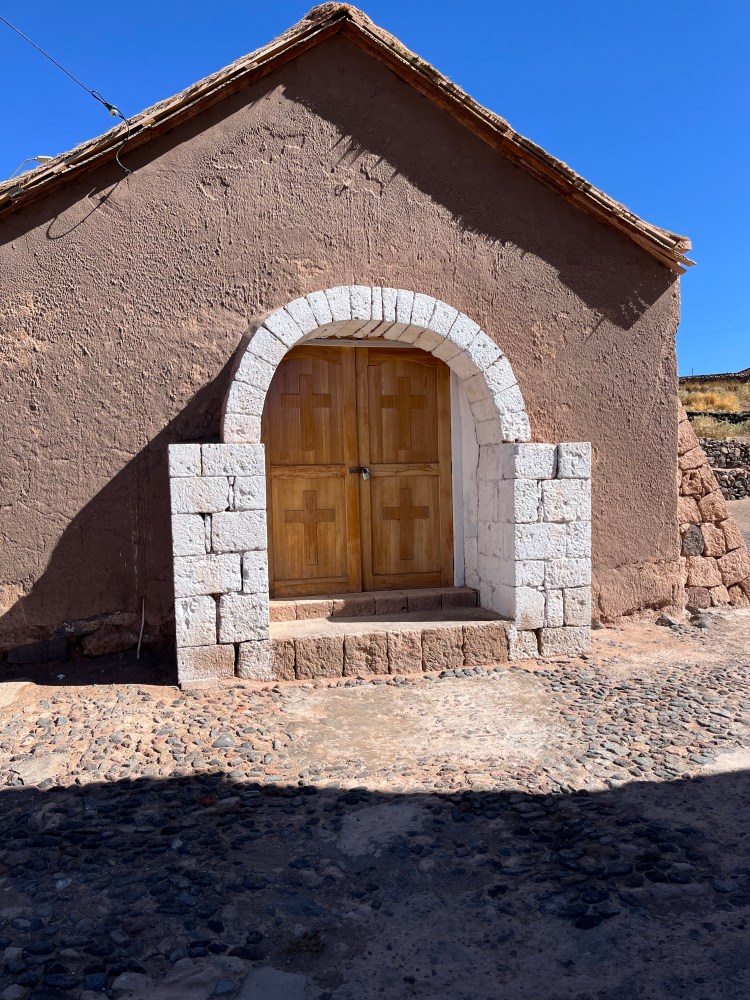
Fully ticketed, we stopped off at the little church on the outskirts of the village.
Church at Socaire
Back on the road, we spotted a group of rheas. Even on maximum close-up, they look like black blobs in the distance, but with binoculars you could clearly see one large one and a bunch of small ones. A little further on, we saw three vicuñas running in the distance; again, no photos.
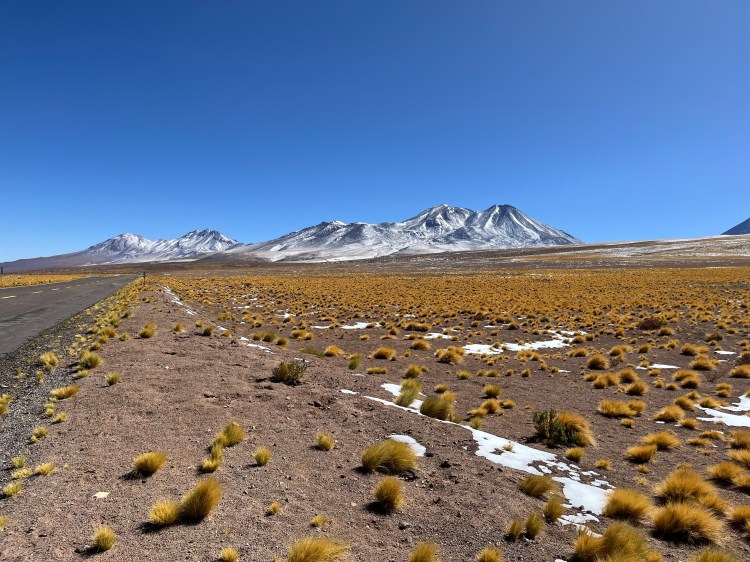
The landscape was quite spectacular and there was snow on the tops of the volcanoes around us. Not to mention patches alongside the road.
More volcanoes
We eventually turned off the road onto a dirt track that climbed quite steeply. This was the route to the Miscanti lagoon. Which was closed! There was a padlocked bar across the track; it appears there was too much snow at the top of the pass.
So we turned round and headed down again. Instead, we found a somewhat sheltered nook in the middle of nowhere and Barbara spread out our lunch. Not a bad way to spend an hour.
We decided not to try the lagoon again; there’s no mobile signal up there so we couldn’t contact anyone to find out. So back down on the main road we went. Suddenly, as we turned a corner, I spotted a troupe of guanacos; an alpha male, several females and some young ones. Sadly, as soon as we stopped the car, they ran away.
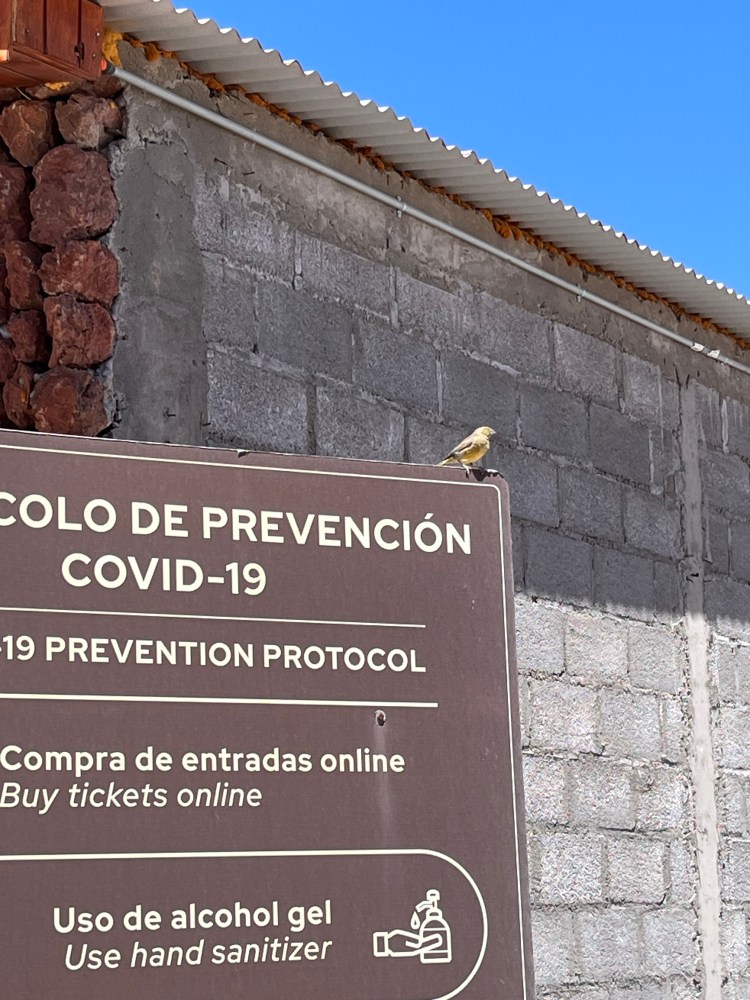
Back in Socaire, we finally did manage to capture a photo of some wildlife; a Greenish Yellow Finch posed for me!
Greenish Yellow Finch
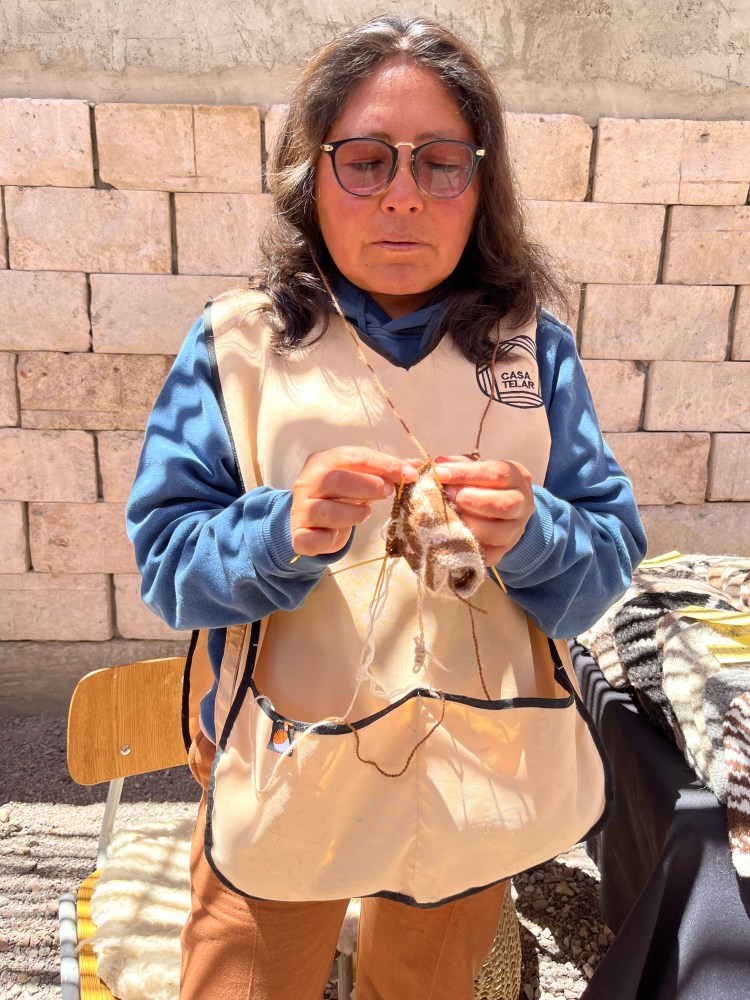
From the tourist centre, we walked up to the home of a traditional weaver, for a demonstration of her art. She uses llama, sheep and alpaca wool, all in natural colours. We watched her working on a small traditional loom, making a bookmark. It is so complicated that she needs to follow a pattern. She also showed us how she uses cactus spikes to knit small, delicate objects, in this case a sock with a llama pattern.
Knitting with cactus needles
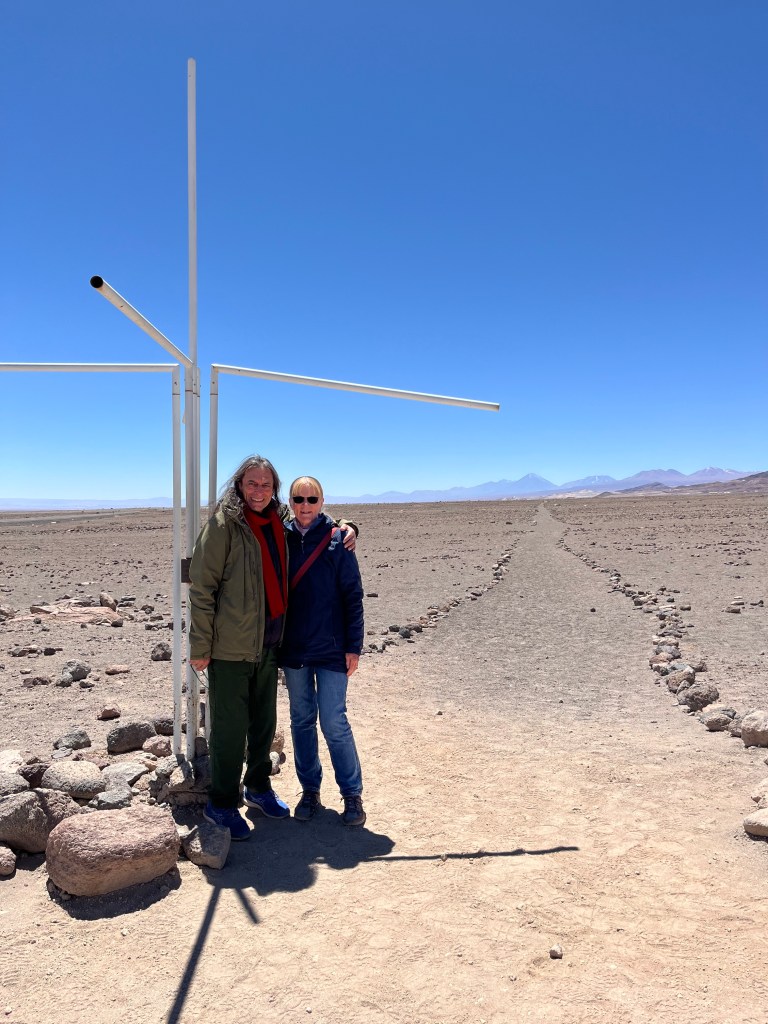
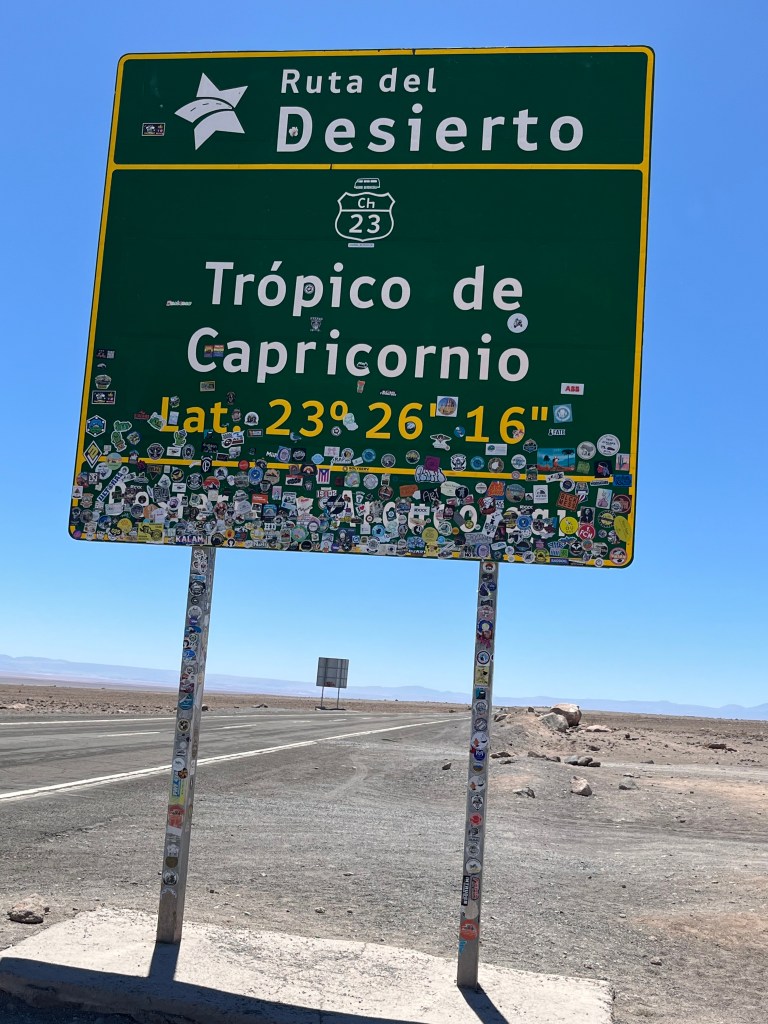
Our next stop was at the Tropic of Capricorn. The sign for this seems to have become a target for stickers from all over the world.
Tropic if CapricornEven in the desert
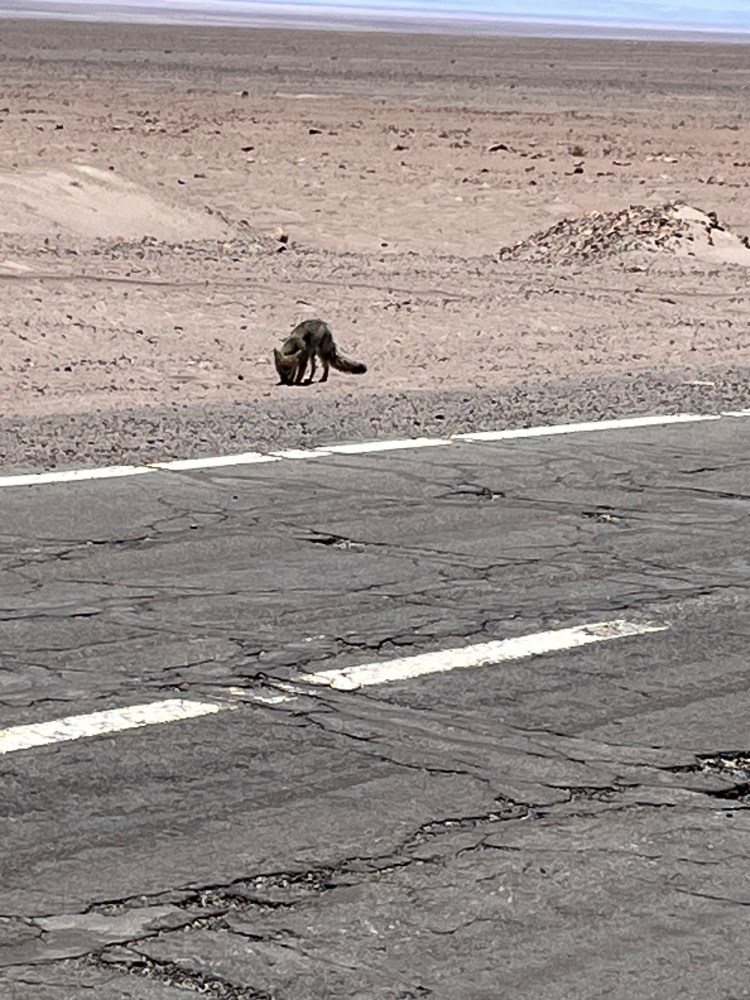
Further on, we spotted something crossing the road ahead of us. It turned out to be a Cheya, or grey fox. This time it didn’t get away. In fact it wasn’t bothered by us in the slightest.
Grey fox
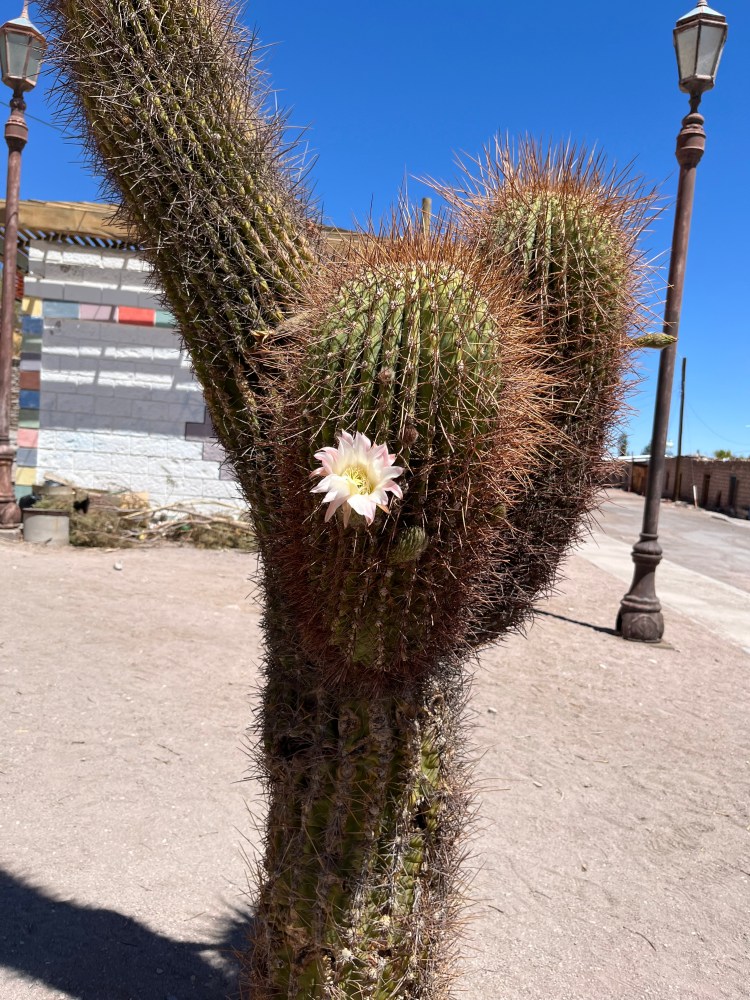
Our final stop for the day was Tocanao, where we saw a cactus in bloom. This is the classic type of cactus that you see in Hollywood films, all arms and spines.
Cactus in bloom
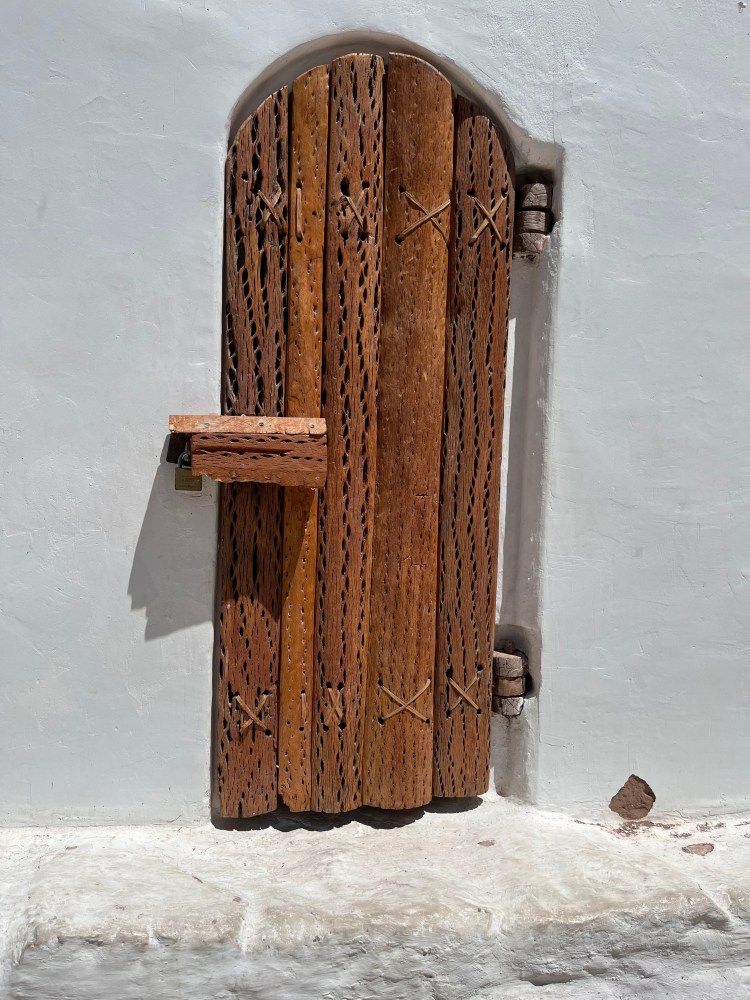
You don’t see too many in the wild because they are valuable for their wood in a land where there are no trees. But they only grow a centimetre or so per year which is why they’re protected. The local church had a beautiful door made of this wood bound together by guanaco leather.
Cactus wood door with guanaco leather bindings
Back at the hotel we had afternoon tea and biscuits, then we’re off to look for dinner.
Tomorrow morning we’re off back to Santiago and then on to Valparaiso.
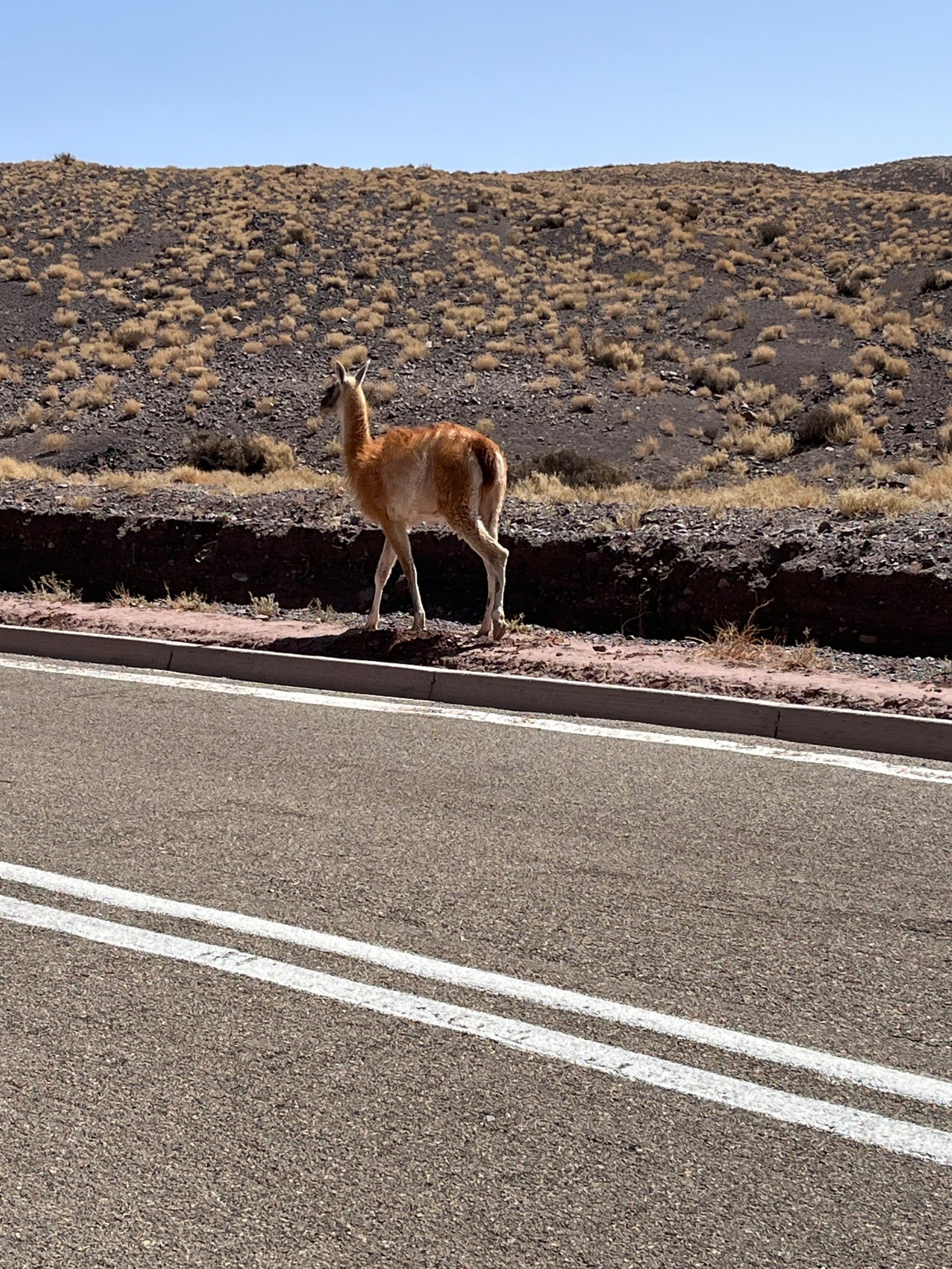
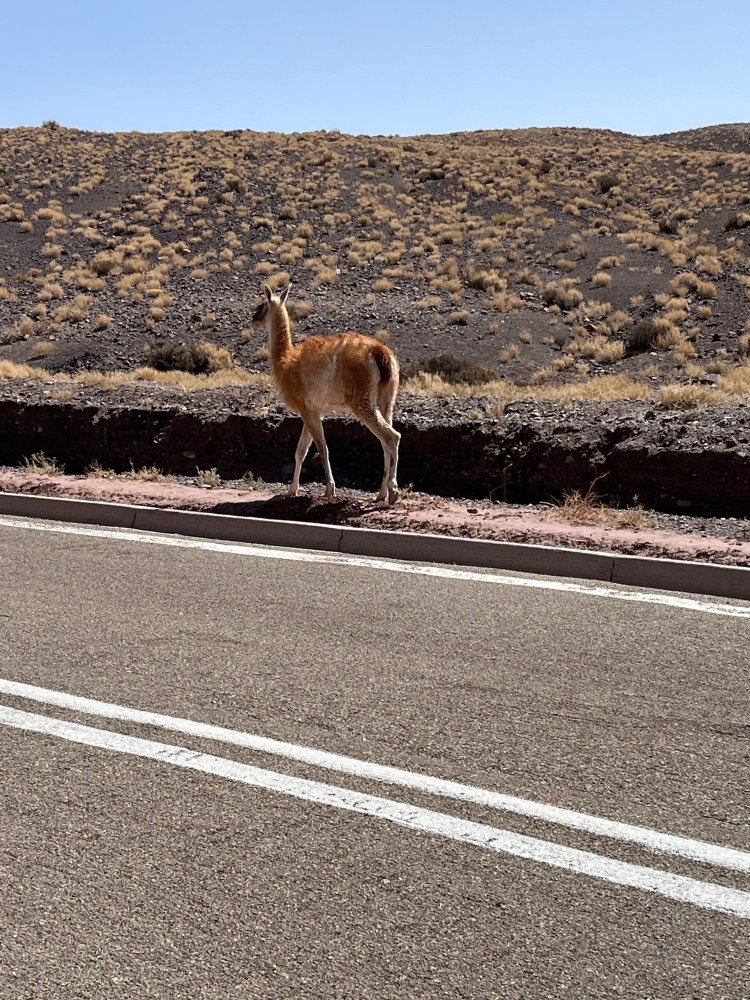
Barbara was our guide for the afternoon’s tour, to Yerbas Buenas and the Rainbow Valley. Yes, the valleys around here are dead abundant! We started by going back towards Calama on the highway and through a pass at around 4,000 metres. Then we turned off onto a secondary road, where we were lucky enough to see a guanaco, a wild llama. We went on a photo frenzy while he totally ignored us!
Guanaco
We saw another three as we drove along, but weren’t able to stop.
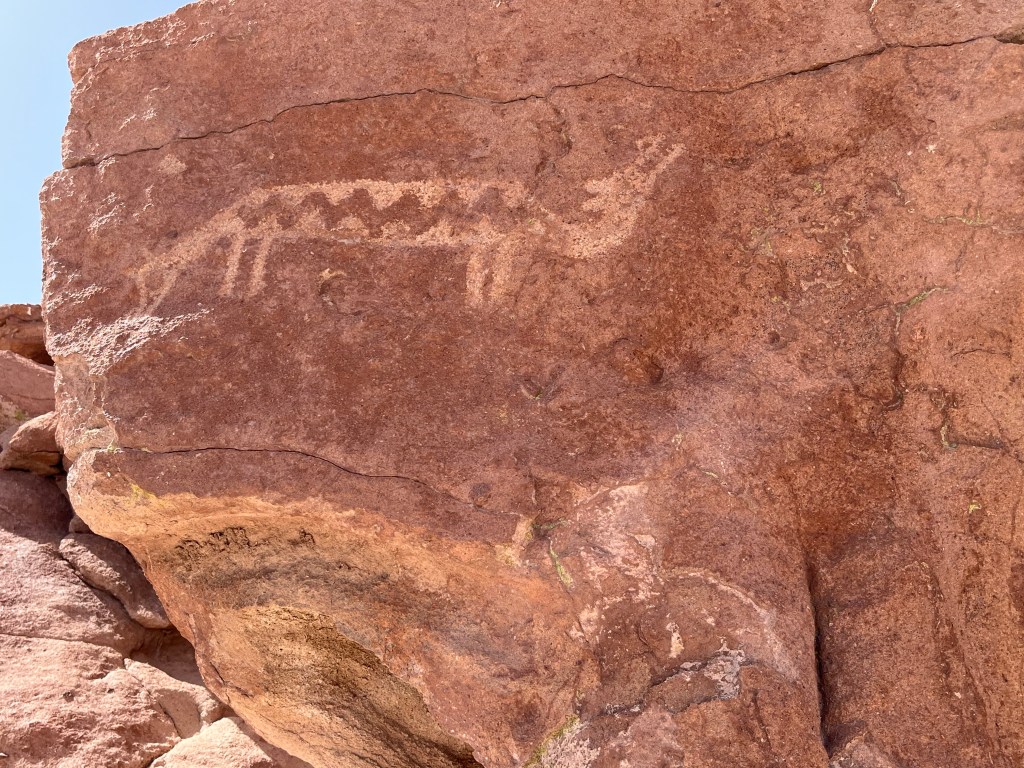
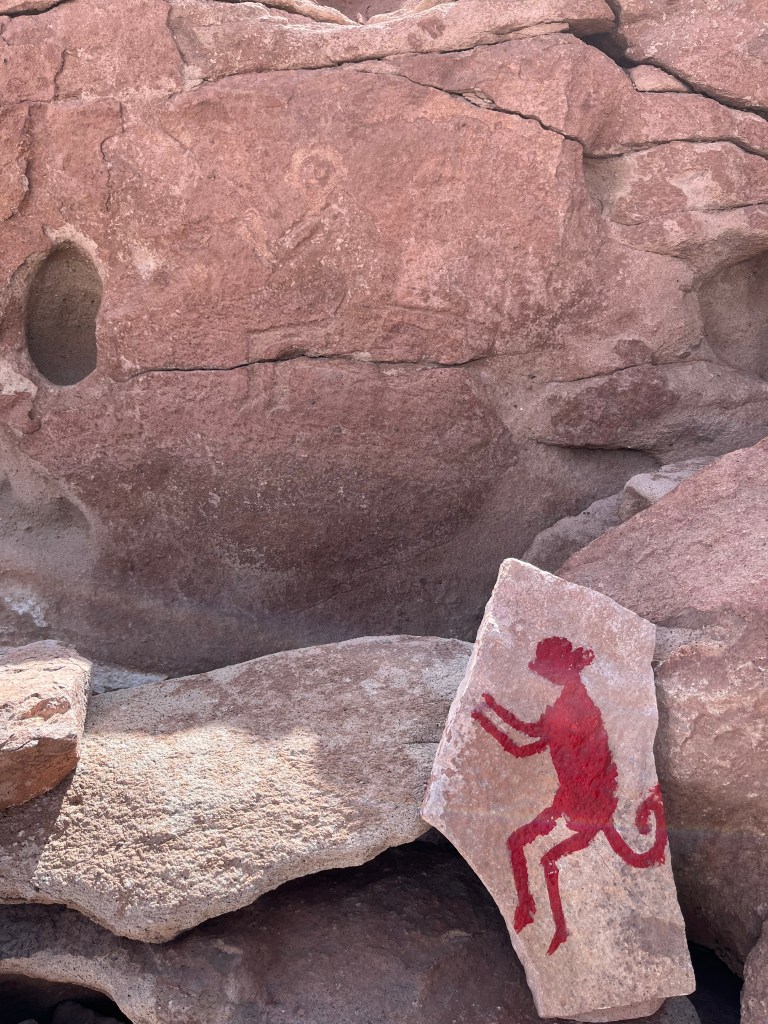
Eventually we came to Yerbas Buenas, or good herbs. I asked Barbara how the place got the name, given that there aren’t any plants in the area other than cacti, but she couldn’t tell me. What it lacks in plants it makes up for in cave art. The place is basically a rocky outcrop used by passing caravans as a resting place, way back before the Incas.
Since they didn’t have TVs or Smartphones, the travellers would spend their evenings carving on the rock walls. Some of the art was quite sophisticated, others were just stick figures.
Cave ArtCave art plus recent key
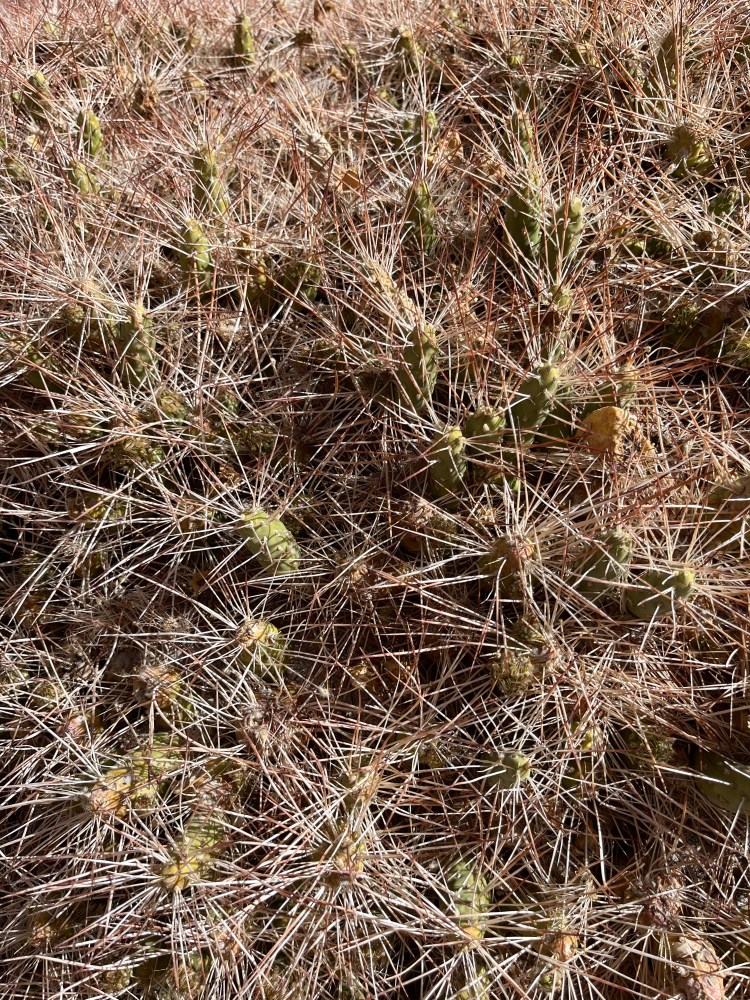
We also got up close to cume, a cactus that you see a lot as you drive through this area. It has very sharp spikes to protect itself, but the spikes are softer in the mornings. Guanaco are aware of this and they come along first thing and attack the base with their feet to break off bits of the plant. It also has the nickname “Mother-in-law bush” because it is so spiky.
Mother-in-law bush
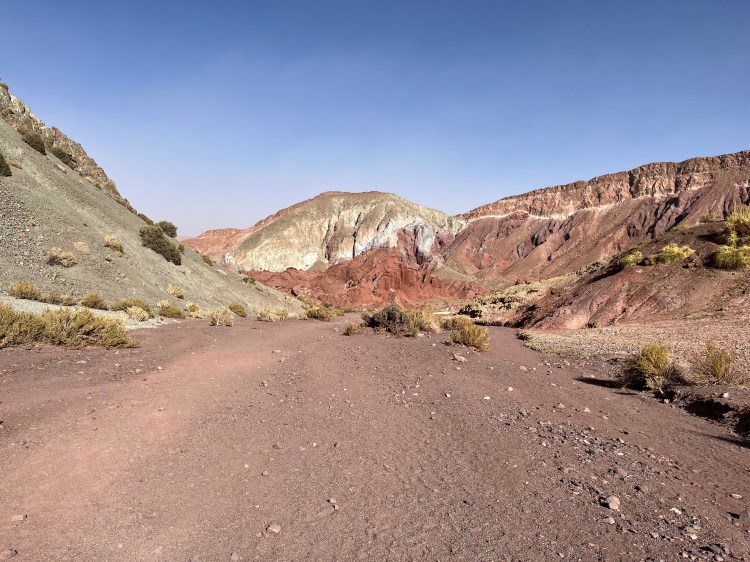
From there we continued to Valle del Arcoiris, or Rainbow Valley. This is an area where the rocks are different colours depending on when and how they were formed. If you want the geological explanation then google it, because I don’t know my magma chamber from my tectonic plate.
While you can’t really make a rainbow out of the rocks, there were brown, red, blue, green and purple varieties forming a magnificent landscape. Which we took full advantage of as we stopped for a glass of wine and some local delicacies on the way out.
Rainbow Valley
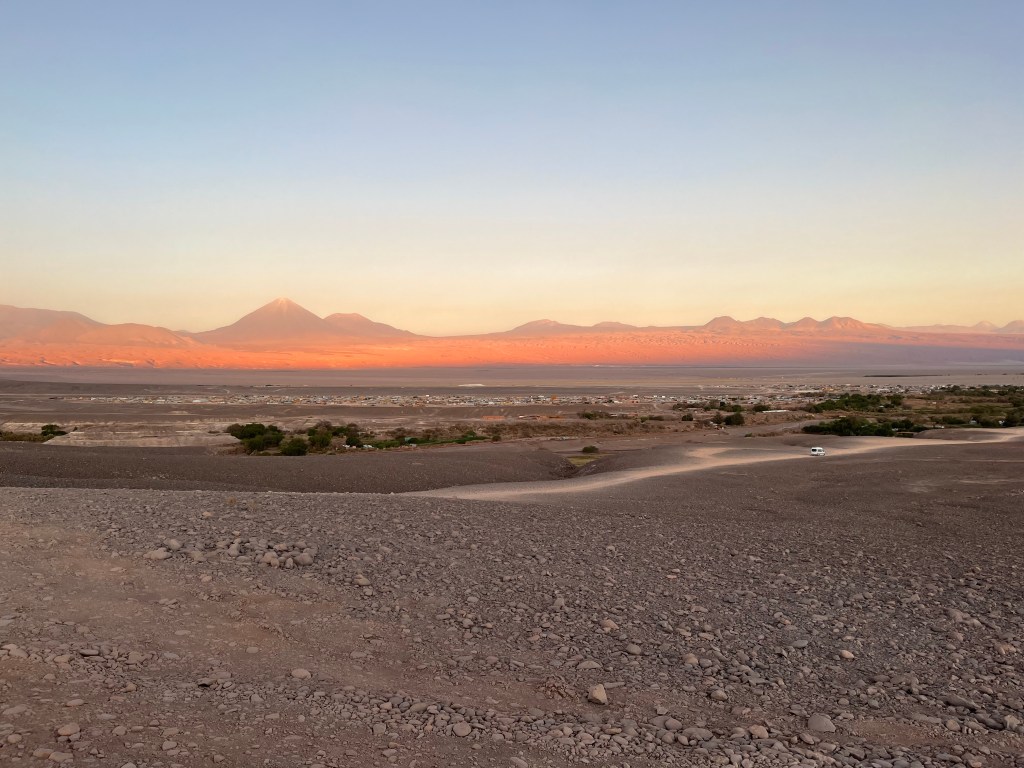
From there we hightailed it back to Mars to watch the sun set over the Andes.
We were surprised how smoothly our transfer to Chile went. Unlike our last experience at Lima, we got our bags checked in and dropped without a problem. Getting through security was chaotic but fairly quick. Our flight was more or less on time and we landed early, which was good because we only had two hours between flights.
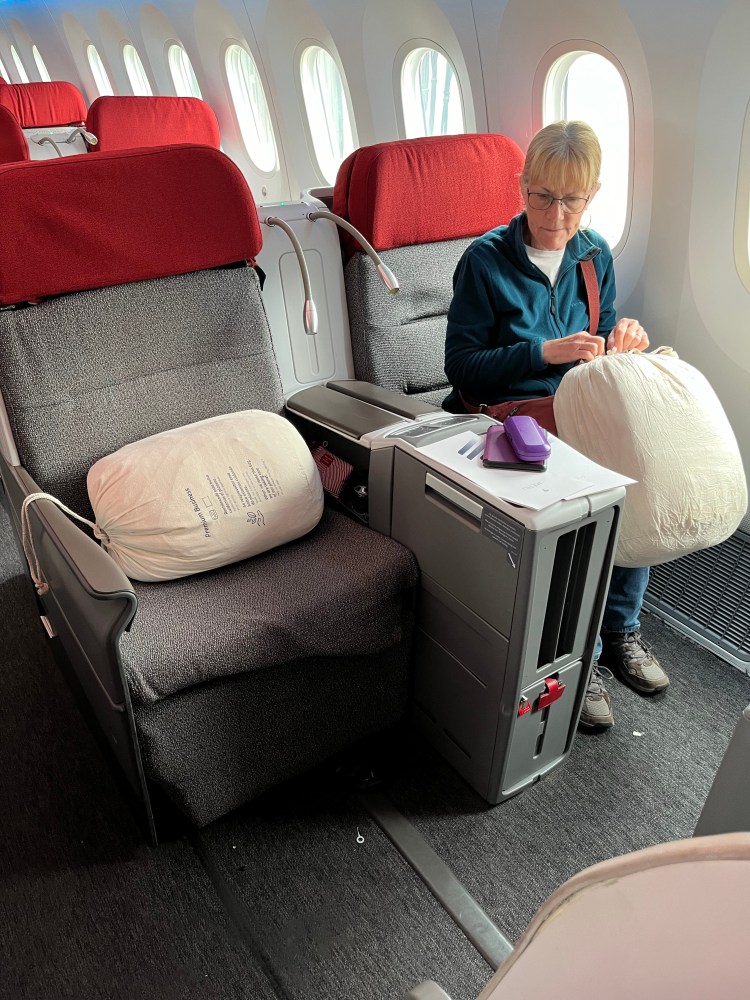
Diane and her swag bag
Immigration wasn’t too bad and we got to the baggage claim just as our bags came out. Straight through customs, found the transit desk and dropped our bags again and within 40 minutes of landing we were in the domestic departure terminal.
I managed to blag our way into the VIP lounge for a quick snack and then we were off again to Calama, where Jose met us and transferred us to San Pedro de Atacama. He also answered something we’d been wondering about on the flight – why almost all the passengers were men. Just outside of Calama is the world’s largest open pit copper mine. The guys on the flight are all workers coming back for their 7-day shift.
If Chile weren’t two hours ahead of Peru we’d have had quite a nice evening.
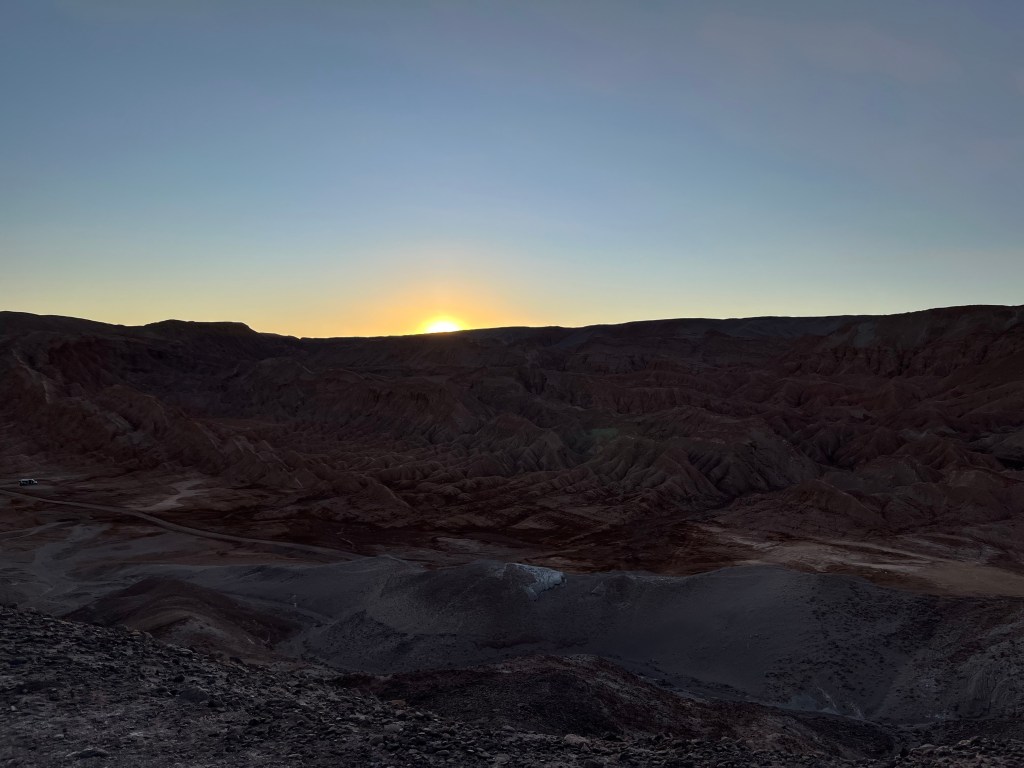
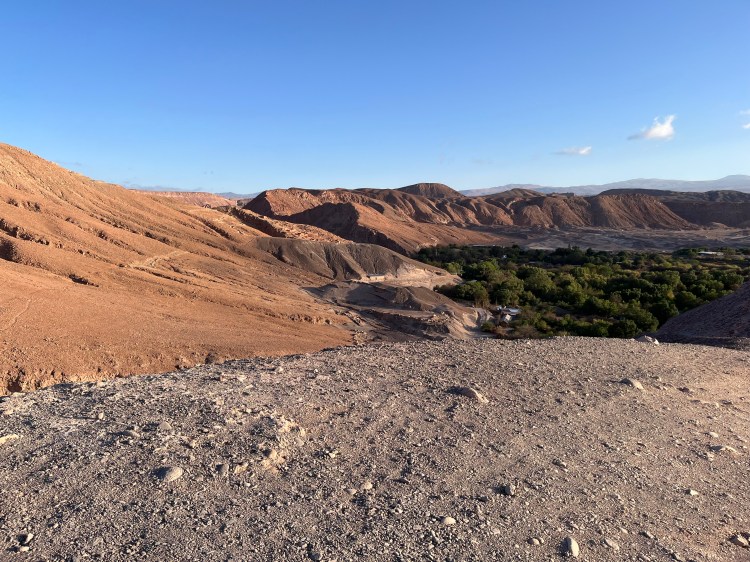
Next morning, Maurice picked us up and drove us to Mars valley for breakfast. This involved a couple of minutes on a nice tarmac road before swinging onto the desert and up a dirt track to a mountain ridge. There he laid out a buffet for us and we sat and had breakfast watching the sun rise above the ring of volcanoes opposite. And it was freezing!
Mars
However, the scenery was beyond spectacular. We are at the start of the salt mountain range, formed 26 million years ago. This isn’t salt like we saw in Maras. It contains arsenic, so is used only for mining lithium, which is big in this area where Chile, Bolivia and Argentina meet.
As always, it’s hard to capture the majesty of the landscape in a photo.
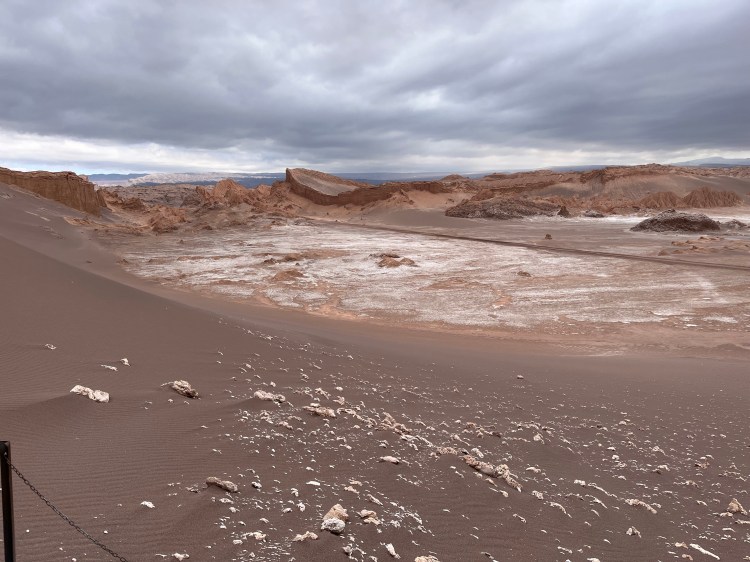
From there we drove to the Moon Valley where we could get up close and personal with the rocks. Maurice seemed to be fascinated by gypsum; we saw it in powder form, clear and in crystalline veins snaking through the rocks. I’m afraid there’s only so much I can take in about geology.
Moon Valley
And finally, we drove to an Ayllus, or traditional Andean community, to taste some typical Atacameñan food. We walked around the garden looking at the various vegetables they grow. We also saw turkeys, ducks, goats, sheep and a llama. However, we didn’t feel comfortable with the conditions that the animals are kept in, so we didn’t stay long.
Well, we started our trip to Peru with a Pisco Sour and we’ve ended it with a Pisco Sour. After an uneventful flight, we’re now back in Lima, ready to fly out to Chile in the morning.
Things we’ve learned in Peru include:
The number pad on credit card machines is in a different order to all others I’ve seen. Since I only remember my PIN by the shape it makes on the pad, this can be a problem.
Every car we’ve been in has had a manual transmission.
Peru has around 3,000 varieties of quinoa.
And 4,000 varieties of potatoes.
Baby alpaca wool doesn’t come from baby alpacas.
They must export all the best coffee, because we haven’t had a decent cup yet.
Peru has the longest traffic light countdowns we’ve ever seen, frequently over 120 seconds.
A matrimonial room isn’t the same as the honeymoon suite. It just means there’s a double bed.
We had to pack our bags this morning due to our change of rooms. We then met Gerardo, the local Audley guy who was going to give us a tour of this lovely city. And as a 7th generation Arequipan he is well placed to do so!
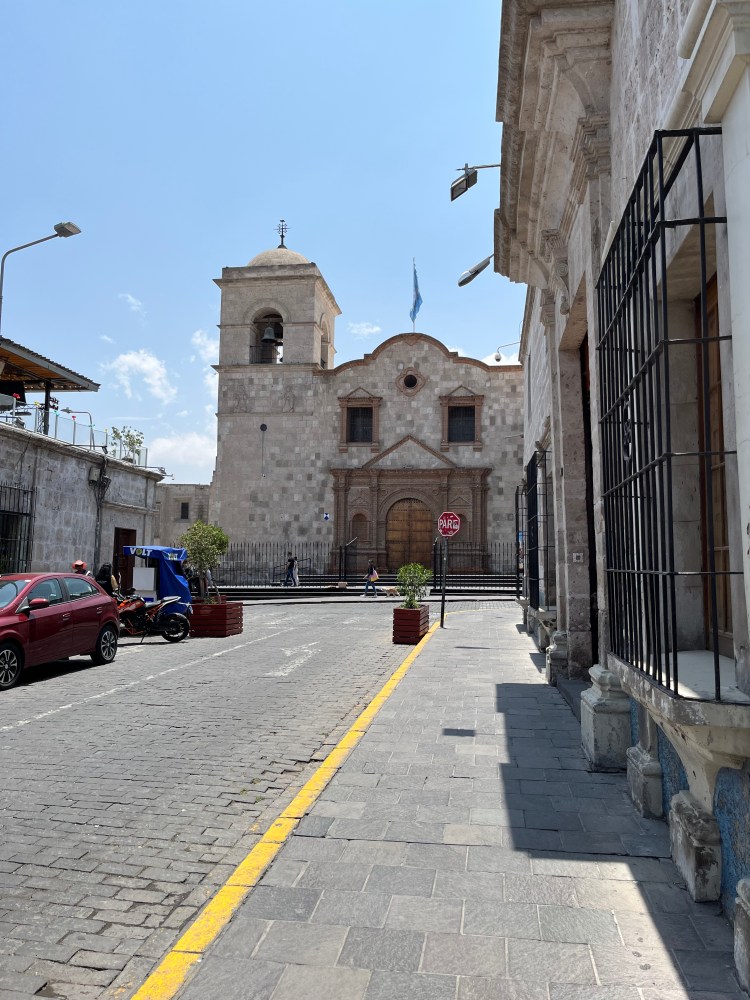
We walked up to the San Francisco church and Gerardo told us some of the history of Arequipa. When the Spanish arrived it was an agricultural area, with terraces built of Silla stone – the product of compacted volcanic ash from one of the three volcanoes around the city. This heats up in the day and keeps the roots warm at night.
St Francis church
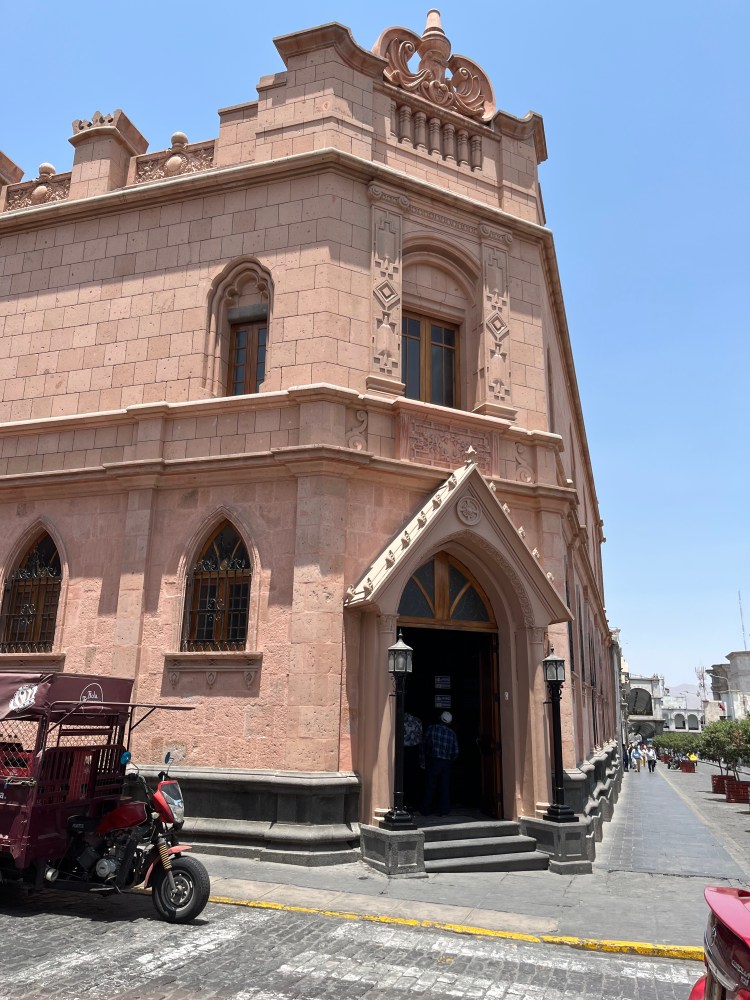
When the Spanish recognised the thermal properties of sillar, they used the stone to build all the buildings of their new home. Hence Arequipa became known as the White City. The original buildings were very simple in style, but after several earthquakes, rebuilds have used new designs, lending a very uncontrolled aspect to the architecture. The only building we saw that wasn’t white was the Bishop’s Palace, build of pink sillar.
Bishop’s palace
As we passed several alpaca shops, Diane asked how all the products could be 100% baby alpaca. It turns out that it isn’t the alpaca that is a baby! Wool from the sides of the body is called baby alpaca while wool from the back is called royal. The rest is ordinary alpaca wool. So alpacas can provide baby wool into their dotage!
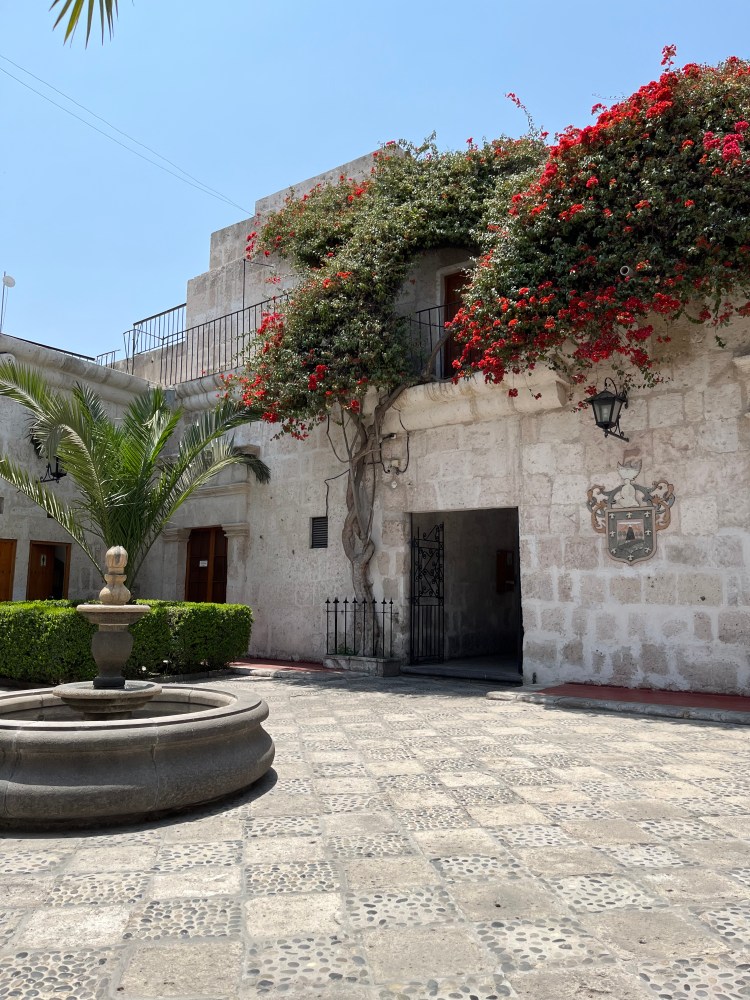
We visited a couple of houses, one small, the other larger. They share the same design, with an inner courtyard surrounded by public rooms and a second courtyard with the private spaces. The larger house had a third courtyard, but not everyone can afford to be a bank!
A small courtyard
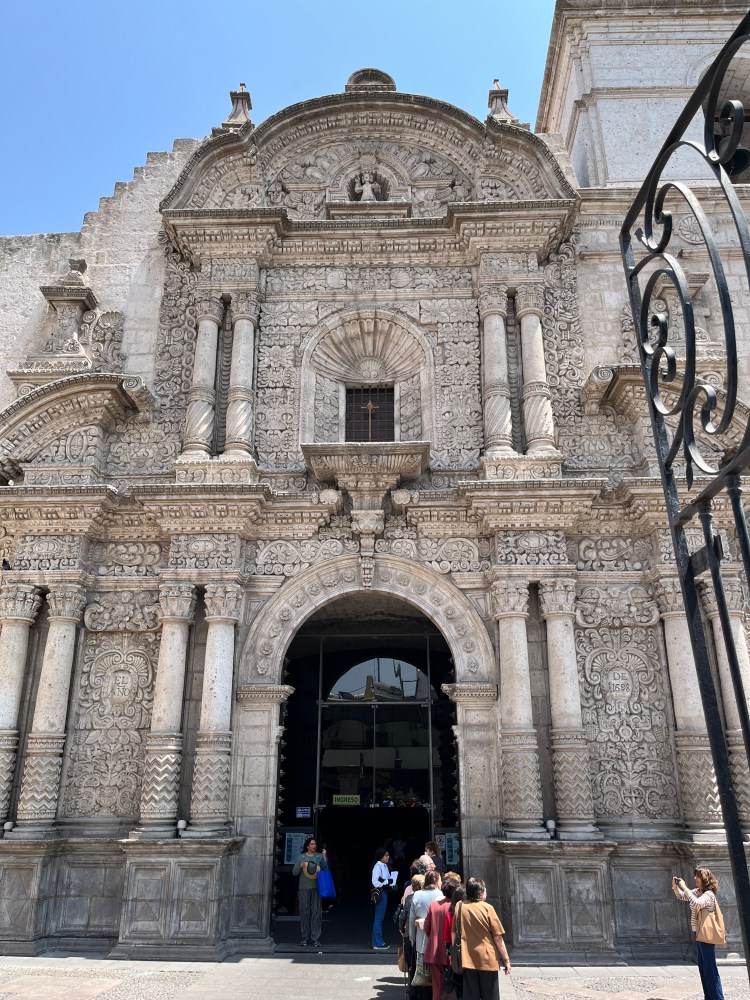
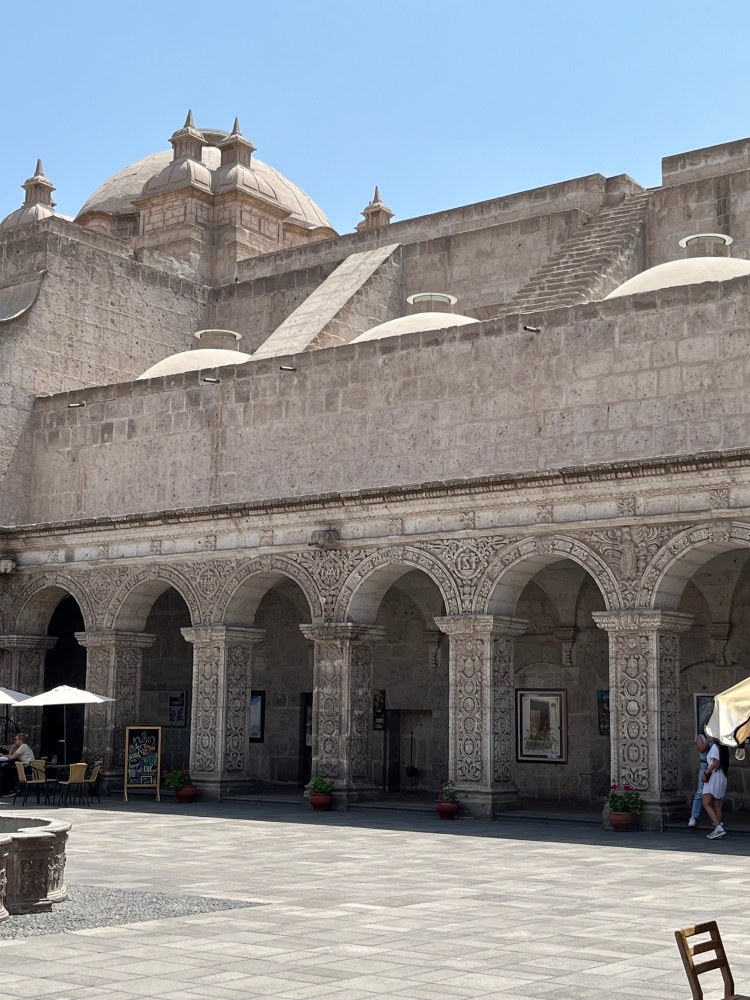
We arrived on the Plaza de Armas, a huge square with the neo-classical cathedral taking up one side. Unfortunately, it is only open at certain times; the next is at 8pm tonight so we probably won’t be visiting. Not far away is the old Jesuit church and associated school. This is in the Barroco Mestizo style, which involves a lot of intricate carvings.
Jesuit church
The building next door was the school until 1768 when the Jesuits were thrown out of Peru. It then became an orphanage and all the carving was covered up until the derelict building was restored in the 70s and the carvings revealed.
Jesuit school courtyard
From there we walked to the Museo Sanctuarios Andinos, home of Juanita, the Ice Maiden. Juanita was a 12 year old human sacrifice dating from Inca times. Human sacrifices weren’t uncommon in Inca times, but the children chosen considered it an honour and privilege to serve their community in this way.
The snow on the volcanoes provided a constant supply of water to the lands around Arequipa. When one of them erupted, the snow vanished and the crops failed. Juanita was chosen to appease the gods and bring back the snow. She would have climbed to the top of her mountain attended by priests and other children and then laid down on an alter. She was killed by one blow to the head, after which she was wrapped up and placed in her grave, along with her belongings. The grave was then covered with a slab of stone.
It appears to have worked because the snows returned, everything went back to normal and Juanita was forgotten. That is until 1995 when a lighting strike hit the slab covering the grave. Rain entered the tomb and floated Juanita out and causing her to roll down the mountain. She was found within a few hours and her body was remarkably well preserved, having been frozen immediately after her death. One side of her face thawed while she was outside, but otherwise she was unharmed.
Juanita isn’t always in residence, so we aren’t sure whether we saw her or a model.
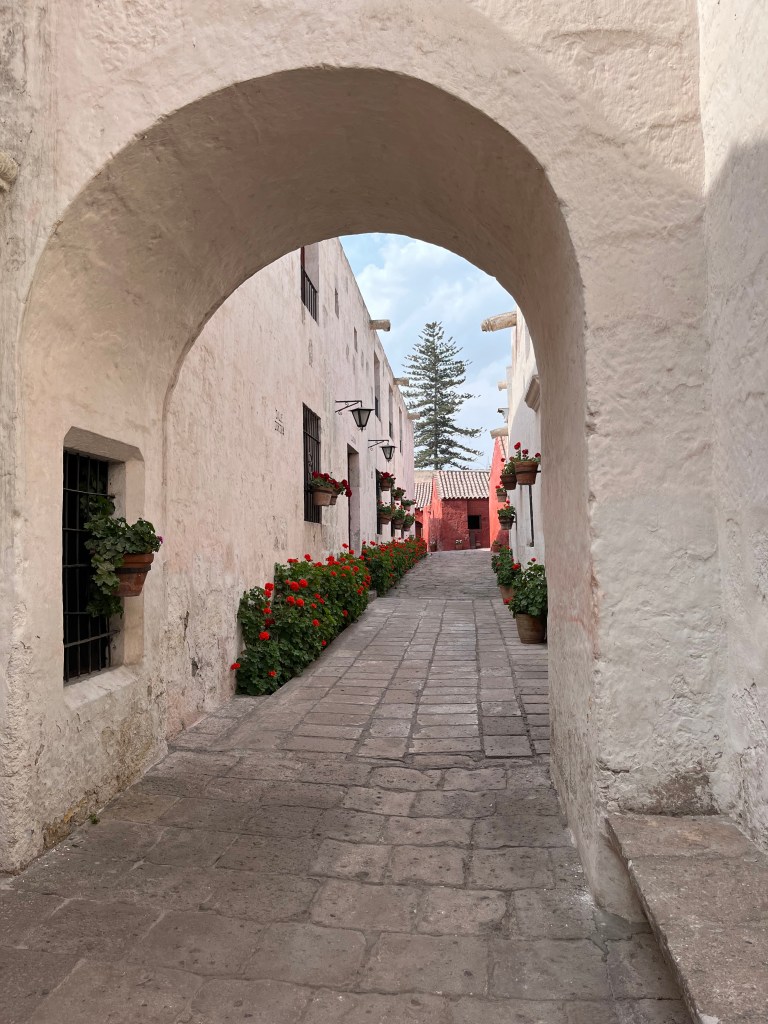
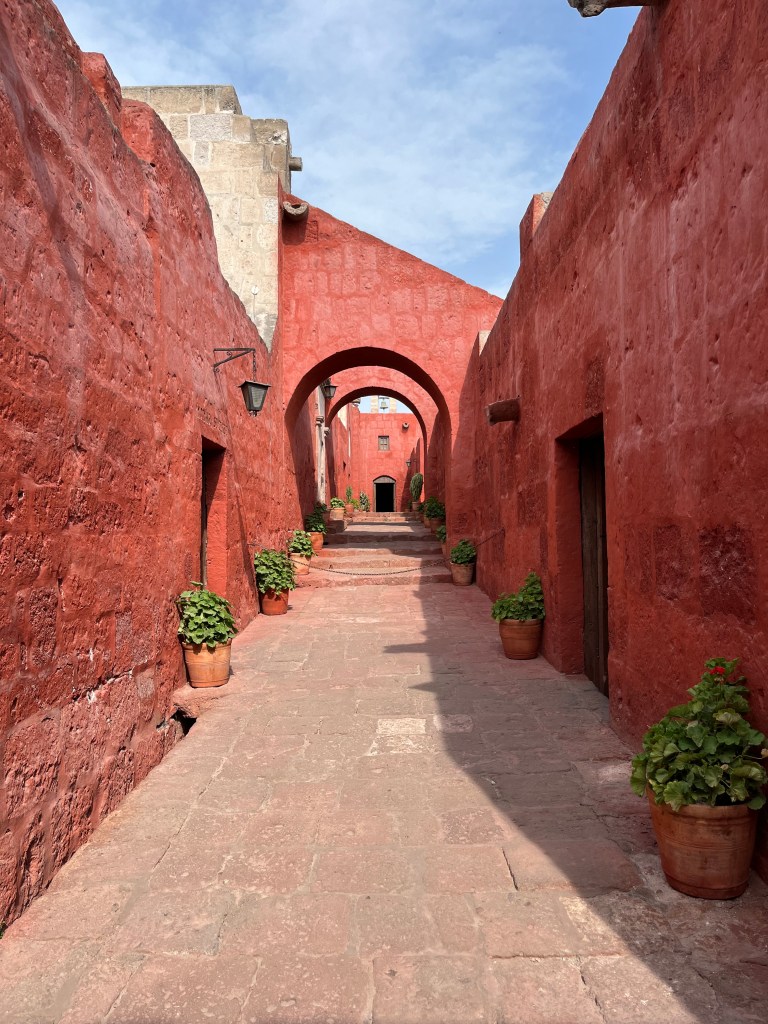
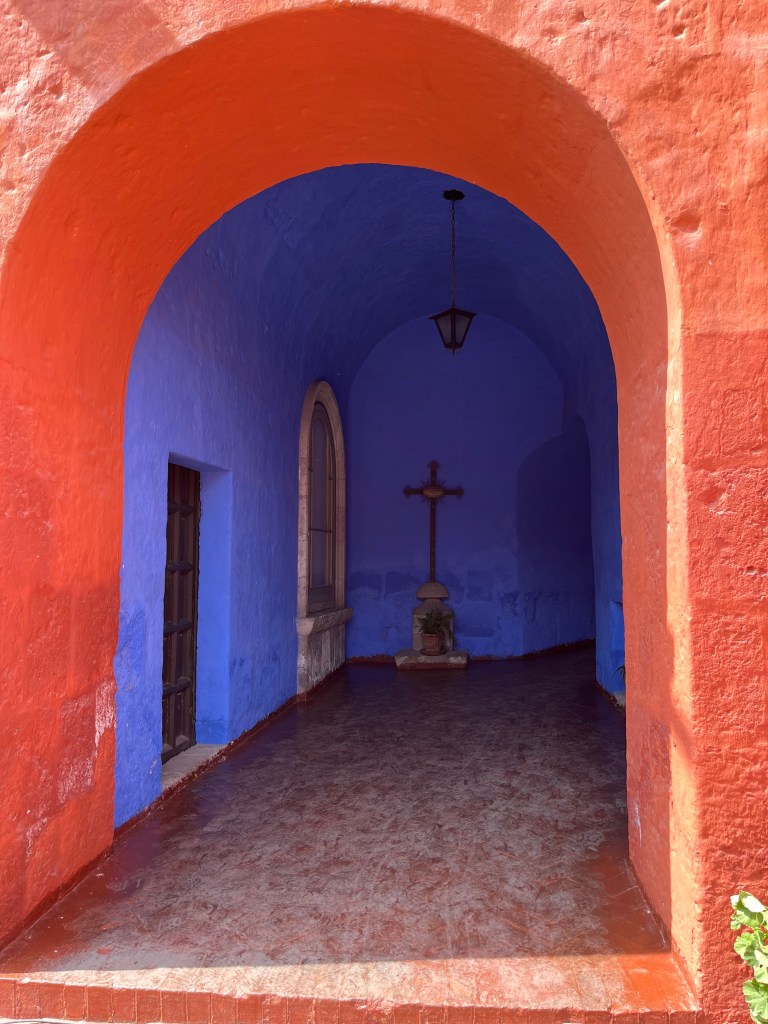
Finally, we headed to the Santa Catalina convent for a guided tour with a scary guide. A walled colonial town inside of Arequipa, it was opened to the public in 1970 after 400 years of secrecy. There are still about 20 nuns living there, but they have their own private section. Having had a look at their bedrooms, kitchens and communal spaces, I’m not sure that being a nun was such a hardship compared to living on the outside.
A lot of the walls are either red or blue. However, they are also white sillar stone. When the convent was opened commercially, the walls were painted because they were too white for tourists!
Santa CatalinaSanta CatalinaSanta Catalina
We asked Gerardo to recommend somewhere we could eat guinea pig. Since by this time it was 3pm, we thought we’d go there for lunch rather than dinner. But there was a huge group in the restaurant and we were told it would be at least an hour before they could serve us. The earliest reservation we could have in the evening was 10pm. Sadly, we gave it a miss and got a sandwich in the Van Gogh café instead.
All in all, Arequipa is somewhere you should go if you get the chance.
 Steve and Diane on Tour